
Emirates' free inflight Internet for Airbus A380, Boeing 777
- Installed on <i>every</i> Emirates A380
- Available on over 30 EK Boeing 777s
- Speed varies from good to unusable
- 10MB for free, 500MB for just $1!
Introduction
Emirates made waves in the global aviation industry late last year with the launch of free wireless inflight Internet aboard its Airbus A380 and Boeing 777 aircraft, which passengers can use whether ensconced in first class or counting down the hours in economy.
The concept is simple: you get 10MB of data to chew through at no charge – enough for that obligatory social media check-in over Wi-Fi – and can pay US$1 for up to 500MB more.
But with space for up to 360 passengers on Emirates' three-class Boeing 777s and around 500 guests on its A380s, can a single satellite-fed Internet connection cope with the increased demand?
Australian Business Traveller gave it a real-world trial on recent Emirates Airbus A380 flights from Auckland to Sydney, Sydney to Dubai and Dubai to Brisbane, plus a Boeing 777 service from Melbourne to Singapore – here's how it fared.
Emirates inflight Internet: getting online
In theory, it's easy to connect on the A380: just open your browser, enter your email address and choose your plan:

Yet in practice, it took several attempts for an email address to be accepted with either option...

... although it eventually clicked over to the next screen.
With the 10MB freebie, it's that simple – no user accounts to be created and no passwords to lose... but don't forget to keep an eye on the usage bar, which shows how much data you've consumed and lets you pause your connection if desired.

We'd suggest keeping this open in one browser tab and using another to surf, allowing you to drop by periodically for quick check-up.
Alternately if you've stumped up the princely sum of US$1 (A$1.31) to browse to your heart's content, just whack in your credit card details and you'll be connected in no time – and yes, they even take AMEX for that.

Our handy tip: The charge appears on your credit card statement as OnAir in Washington, USA and in US dollars – so if your bank is pedantic when it comes to foreign transactions, tell them to expect this one too when advising of your travel plans.
It's a similar story when connecting from your smartphone or tablet, where you'll also spot that progress bar.

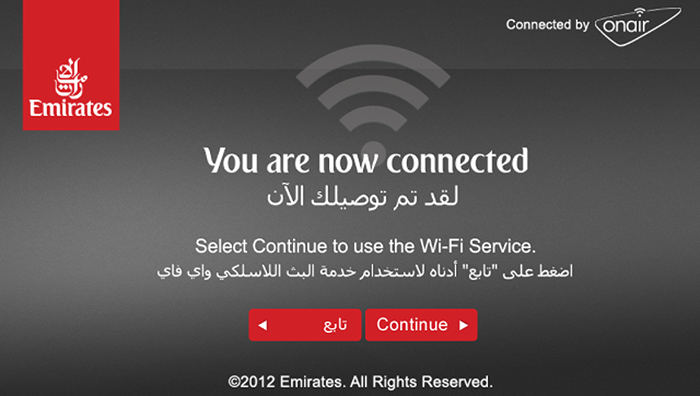
Emirates' Boeing 777s have a slightly different welcome screen...
Content
... which says "you are now connected" from the moment you open the browser, although we kept being redirected to this page until we'd selected and paid for the $1 plan:

That's a known issue on a small number of Emirates aircraft, although when a gold coin gets you online, it's hard to complain.
Emirates inflight Internet: surfing the Web
Whether on the free or near-free plan, we found that the quality and reliability of Emirates' inflight Internet can vary wildly – not just from 'good' to 'slow', but from 'good' to 'give up and try again later'.
The best speeds were enjoyed on the Boeing 777 Melbourne-Singapore flight where downloads rarely dipped below 1.5mbps and uploads tended to hover around 0.08mbps: despite the late evening arrival, that's still an impressive feat on a near-full flight.
Download-wise, that's on-par with an entry-level ADSL connection on the ground and what you'd expect of a satellite connection, respectively, and both combine to prove sturdy enough for general browsing, sending and receiving emails, uploading 'selfies' and using Facebook Messenger and Apple iMessage.
Emirates' early evening A380 service from Auckland to Sydney also delivered similar, usable speeds throughout the 3.5-hour journey, no doubt courtesy of a three-course meal service keeping business class passengers focussed on their forks rather than their laptops.
Onwards from Sydney to Dubai on the overnight EK413 flight, both the upload and download speeds were noticeably lower on the also-full A380, dropping to an average of 0.65mbps down and 0.04mbps up.
That's still usable, albeit on the lower side of the equation, and as passengers began to disconnect and drift off to sleep, those higher speeds from the trans-Tasman flight returned.
Jump forward to the Dubai-Brisbane flight on the journey home, and the only description that comes to mind is "complete disaster".
For starters, the 10:25am departure time dictates that most passengers will be awake – and as it seems, browsing the Internet was at the top of everybody's 'to do' list even several hours into the flight.
It took quite literally eight minutes to get from here...

... to here: the confirmation screen you see before reaching the outside world:

My attempts to then access Gmail were in vain, with nothing but a 'server not found' message to show for my efforts.

I finally got through to my inbox after 21 minutes – that's 29 minutes all up, or 60 seconds short of a full half-hour since first connecting to the hotspot – and had to revert to 'basic Gmail' for the page to be remotely usable.
With the connection too slow for Facebook or to even run a basic speed test, I gave up entirely and decided to complete some offline work before turning in for the evening.

Emirates inflight Internet: the verdict
One dollar inflight Internet: a brilliant concept if there ever was one.
But while the price point makes the service accessible to all – even those only interested in the free 10MB preview – its popularity threatens its functionality, and when it's faster to sit through a complete episode of The Simpsons than to load the Gmail welcome page, something's amiss.
Granted, the value for money was second-to-none from Melbourne to Singapore and on the Auckland-Sydney-Dubai journey, but as a frequent traveller who relies on inflight Wi-Fi to maximise my productivity in the air, I'd normally expect at least a usable speed: even one on the slower side.
That's the same whether I've paid a hefty US$29.95 on Delta, US$1 on Emirates or am enjoying it free and unlimited on Japan Airlines, because for many business travellers, speed and reliability trump small savings at the hip pocket – or more likely, from the company expense account.
My suggestion: continue offering 10MB of data to every passenger, but until satellite Internet technology improves, bump the price for further browsing to a still-reasonable $5.
I know, I know... suggesting that an airline actually raise a fee that's been near-abolished might be a hard pill to swallow, but hear me out.
Your occasional leisure travellers in economy – those most inclined to check-in on social media and who view on-board Wi-Fi as a nifty novelty – can still get their fix without paying a penny.
Chances are a mere $1 price tag isn't going to discourage further Facebooking, but at $5, it's bound to make at least a few passengers think twice before whipping out the credit card.
That means fewer people fighting for the same bandwidth – making the connection speeds faster for all – and is still significantly cheaper than what you'd otherwise pay for global roaming data on the ground.
We'd also peg that most business travellers would happily part with a fiver in exchange for usable Internet on every flight, against shelling out a dollar, hoping for the best and preparing an excuse for their boss if they couldn't receive or respond to a time-critical email.
But when it's working, it's one of the best service improvements we've seen from an international airline to date.
Would you still pay US$5 for inflight Internet, or should Emirates set the Internet completely free, even if the cost comes in reliability?
Chris Chamberlin travelled to Dubai as a guest of Emirates, and to Singapore at his own expense.