
China Airlines Airbus A350 business class, Brisbane-Taipei-London
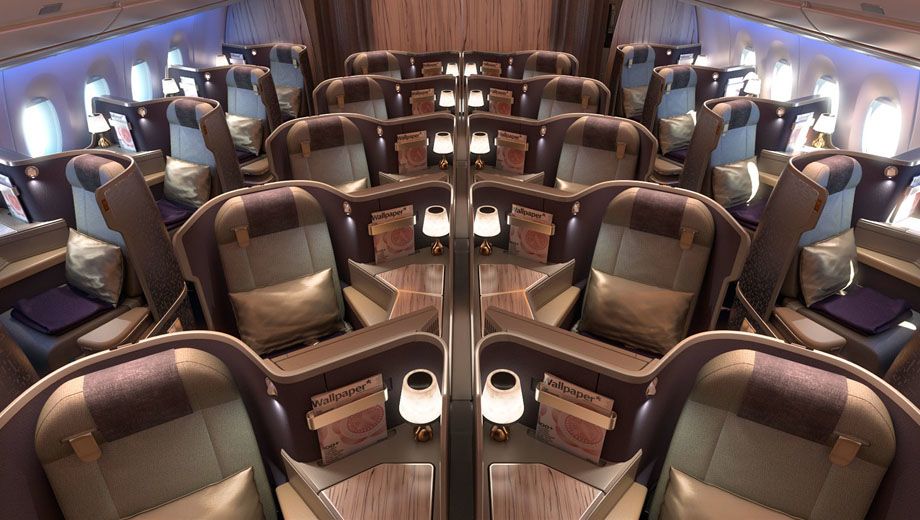
- Fully-flat beds, direct aisle access at every seat
- Currently, free Inflight WiFi
- Competitive business class fares
- Seat is rock hard in bed mode with no mattress topper for comfort
- An incredibly stylish aircraft cabin, without being too 'blingy'
Introduction
Now running Airbus A350s on all flights between Taipei and Sydney, Melbourne and Brisbane, Taiwan's flag carrier China Airlines isn't to be confused with Mainland China's Air China, which also flies to Australia.
Aboard China Airlines' flights, you'll now find fully-flat beds in business class, direct aisle access at every seat, inflight WiFi and more for your journey between Australia and Taiwan, and onward to destinations like London, where China Airlines also sends its A350s.
Australian Business Traveller hopped aboard China Airlines' Airbus A350 on a return business class trip from Brisbane to London's Gatwick Airport to bring you this in-depth review, with travellers from Sydney and Melbourne enjoying a similar experience.
Check-in
- Frequent flyer program: China Airlines Dynasty, SkyTeam. Qantas Frequent Flyer members can also earn Qantas Points and status credits by booking China Airlines codeshare flights between Australia and Taiwan under a QF flight number, although this isn't possible onward to London.
- Checked baggage allowance: 40kg across any number of bags, increased to 50kg for China Airlines' Gold frequent flyers and SkyTeam Elite members, and 60kg for China Airlines' Emerald and Paragon members and SkyTeam Elite Plus cardholders.
- Carry-on baggage allowance: One 115cm bag of up to 7kg, plus one personal item such as a handbag, laptop or laptop bag or camera bag, plus a non-rigid garment bag up to 20cm in depth after folding.
- Airport fast-track: Access to the usual Express Path facilities in Australia, the Premium Gatwick channel on departure from London, and priority check-in, boarding and baggage delivery at all airports. However, there's unfortunately no business class fast lane at security or passport control in Taipei, nor does the airline offer access to Premium Gatwick on arrival in London.
Lounge
In Brisbane, the journey begins with access to the Plaza Premium Lounge, divided into dining, working and relaxation zones with a respectable buffet spread and seasonal dishes cooked to order (such as Pad Thai).
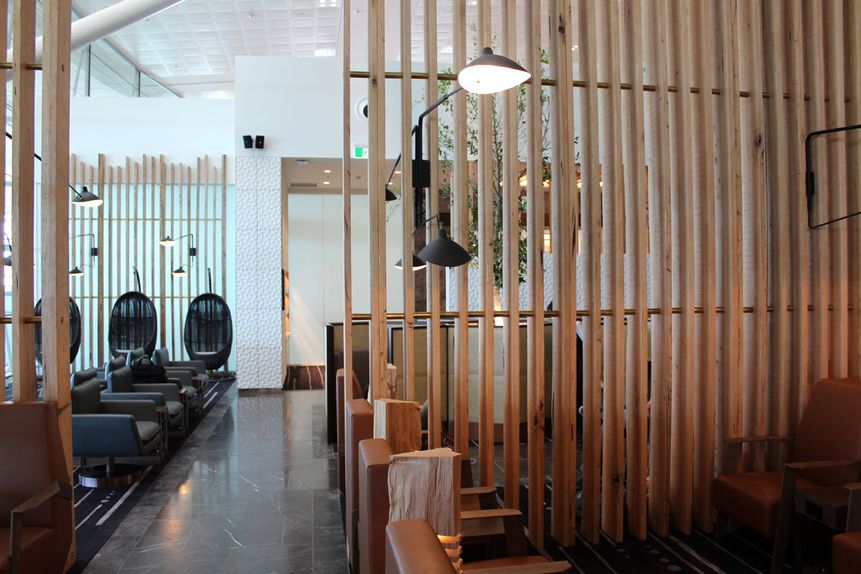
If you're starting your flight in Sydney, you'll instead be directed to the SkyTeam Lounge; in Melbourne, to the Qantas business class lounge; and in Auckland, to the Strata Lounge.
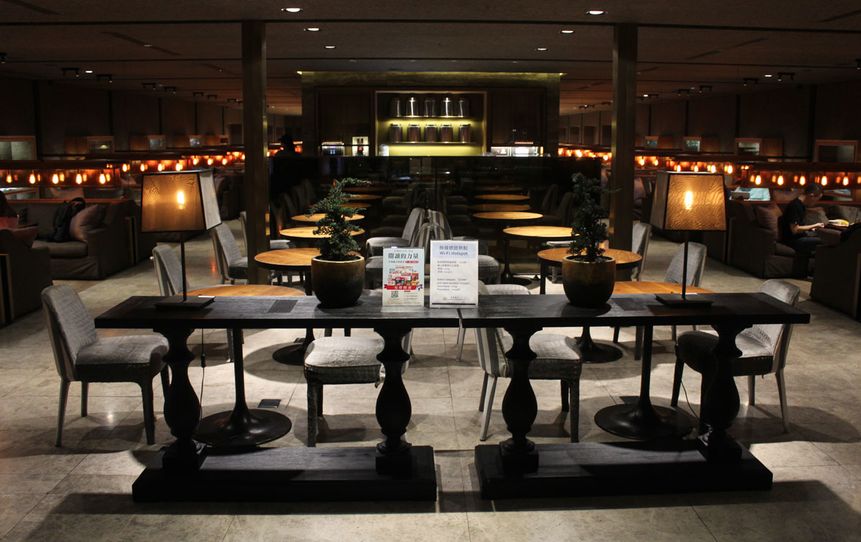
At China Airlines' Taipei hub, flights to London depart from Terminal 1, where a revamped China Airlines Lounge stands ready...
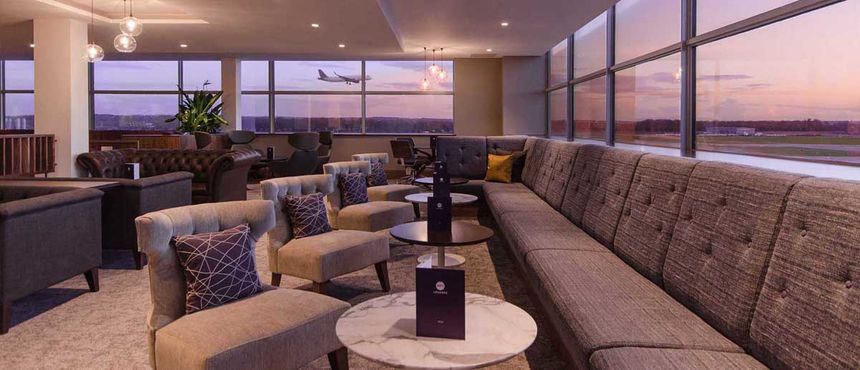
... while in London, China Airlines uses the No1 Lounge at Gatwick Airport's South Terminal, offering an open bar and a la carte dining...
... and back in Taipei, flights to Australia depart from Terminal 2, where China Airlines again operates its own lounges, with the largest being located near Gate D4...
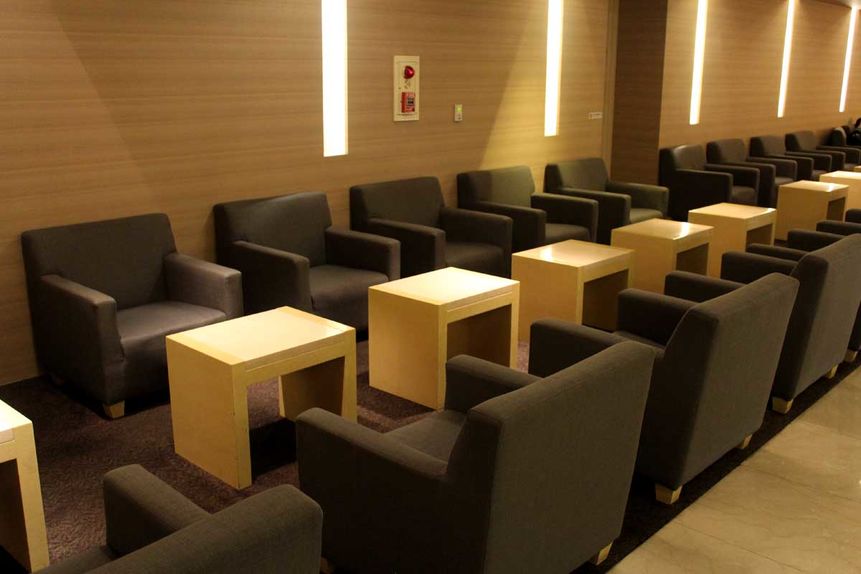
... which we're told will be renovated soon to look more like the newer T1 lounge, but in the meantime, the lounge still offers the basic amenities travellers expect, including shower facilities before those overnight flights to Australia.
Flight
China Airlines now uses its Airbus A350s on all flights to Australia, including 10-14 times per week to Sydney (CI51/52/55/56), daily to Brisbane (CI53/54) and three times per week to Melbourne (CI57/58).
By extension, the airline's Brisbane-Auckland-Brisbane services (CI53/54) also use the next-gen jet, covering passengers darting only across the Tasman, or taking the longer trek between Auckland and Taipei via Brisbane.
Onward to London, China Airlines flies to Gatwick Airport six times a week, with flights every day except Thursdays.
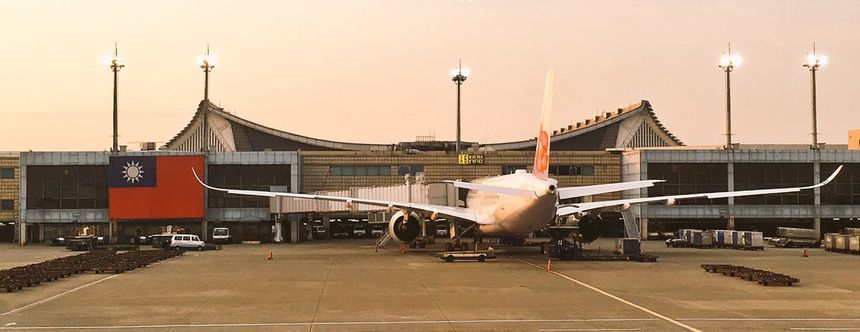
China Airlines is the only airline directly linking Taipei and London, as its major competitor and Star Alliance member EVA Air detours its Taipei-London flights via Bangkok.
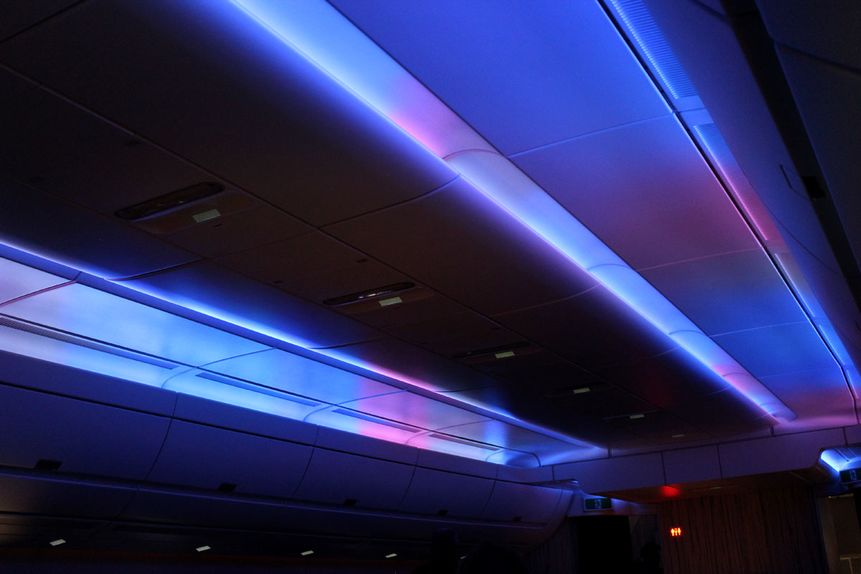
Being a modern Airbus A350 aircraft, a higher cabin pressure means more humidity and a lower 'cabin altitude', which can help reduce the effects of jet lag and make for a more comfortable journey – as can the aircraft's mood lights, which are capable of displaying 16.7 million colours, whether that's softer hues during relaxation stages of the flight...
... or brighter, more intense colours to simulate a sunrise when it's time to wake up:
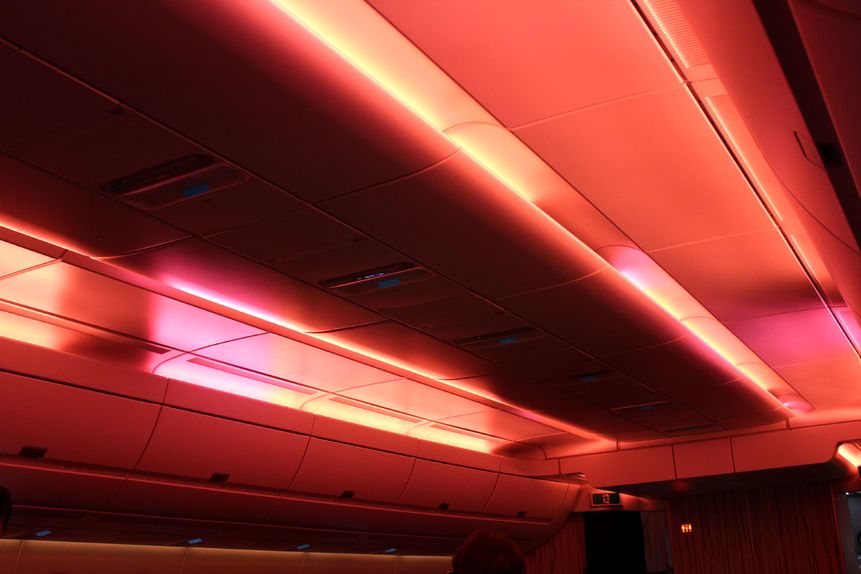
Larger windows also provide better views than older-generation planes, and in business class, there are no central overhead lockers which gives the cabin a more spacious feel, while still offering ample storage space in the side bins.
Seat
Business class aboard China Airlines' Airbus A350s comes in a 1-2-1 layout with 32 seats spread across eight rows, giving every passenger direct and uninterrupted aisle access.
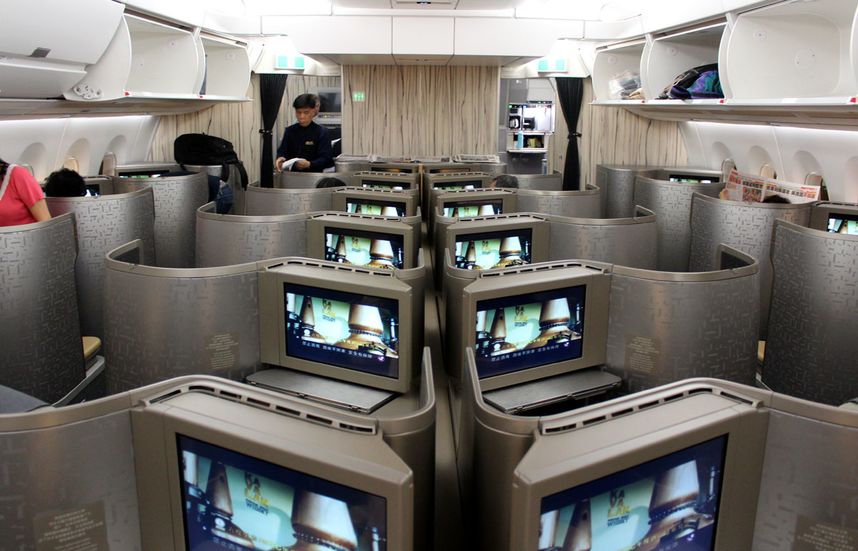
Design-wise, this is a beautiful cabin, with almost everything you see customised to bring a more refined feel to the journey, whether that's on the cabin walls, the carpets, the seating shells...
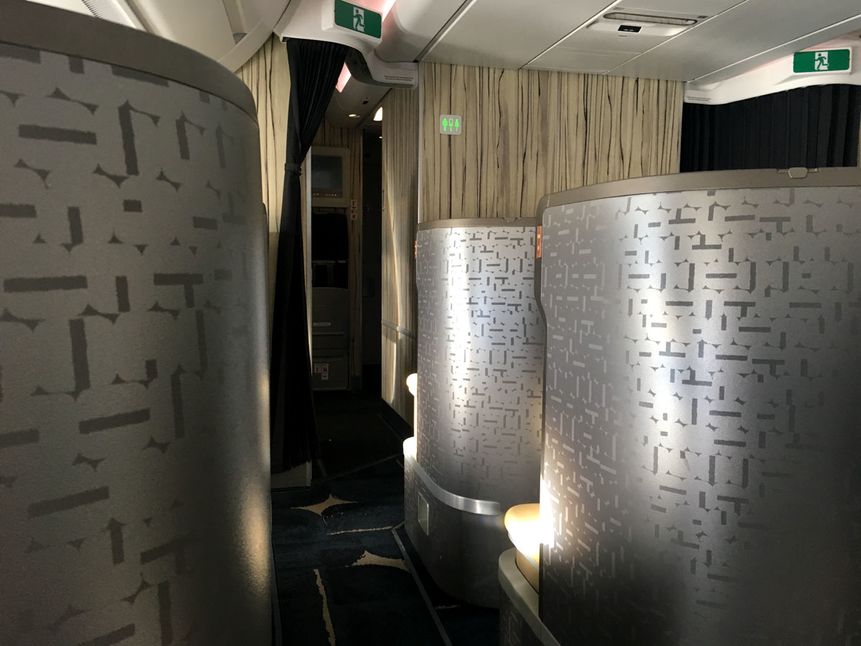
... or at your seat itself, where the side panels adopt hints of the same design without being too 'blingy':
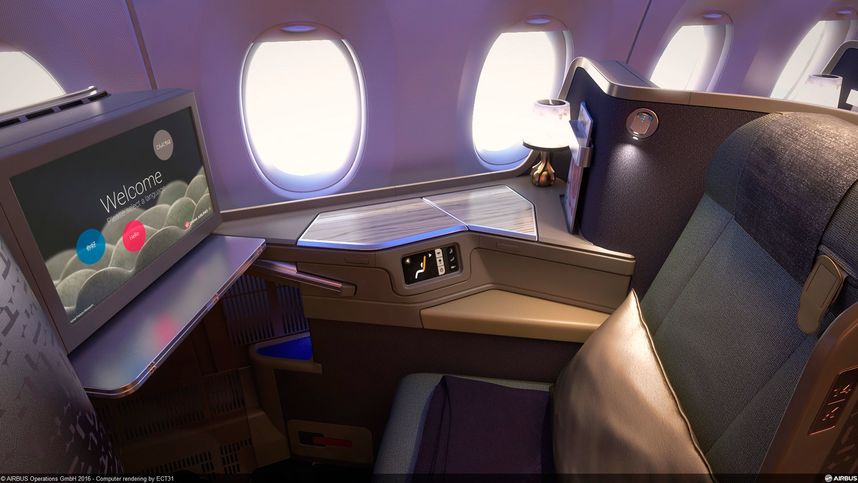
With the cabin lights on plain white mode during boarding, you may not even notice many of the finer touches until you've settled in...
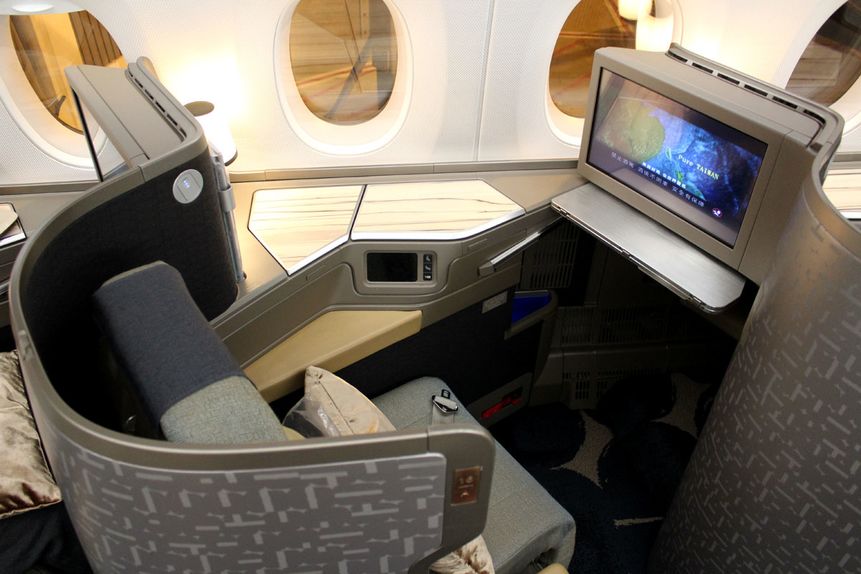
... but once the journey takes wing, there's plenty to like, whether you're flying solo at the windows, or sitting in a centre pair of seats.
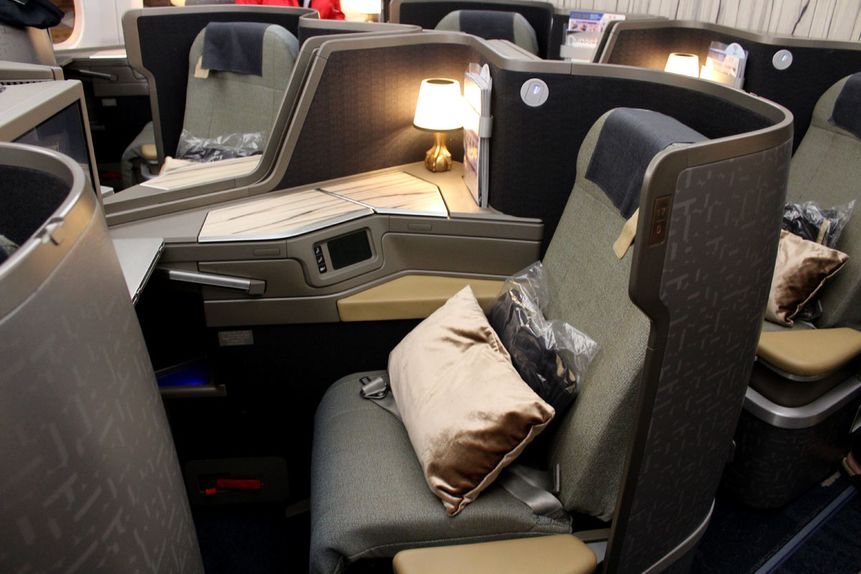
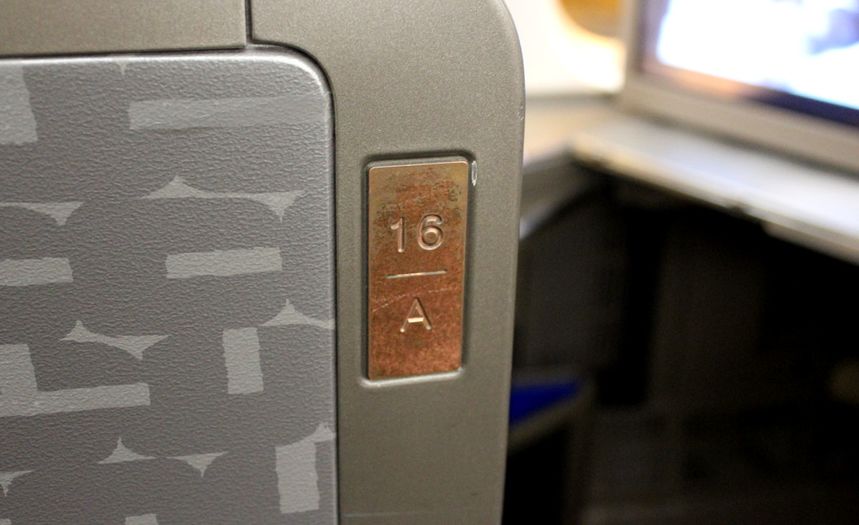
(You'll find the 'A' and 'K' seats by the windows, and the 'D' and 'G' seats in the middle. Even though China Airlines no longer offers first class service on any route or aircraft, seats on this flight begin at row 10.)
One of the first things you'll spot at each suite is a side lamp – a feature typically seen only in first class on other airlines – which has again been designed with style, in patterned glass (tricky to photograph) and an artistic base resembling a bird claw rather than a normal lamp stand...
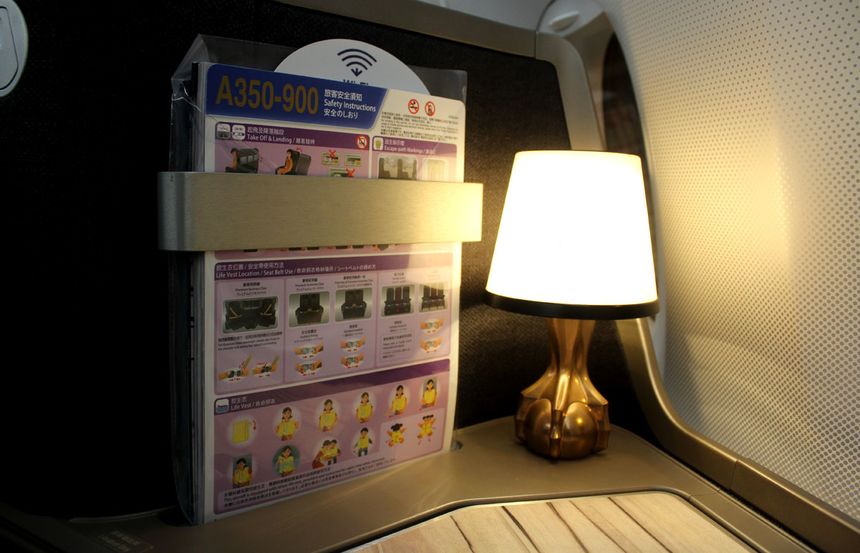
... next to the textured cabin wall and side shelf...
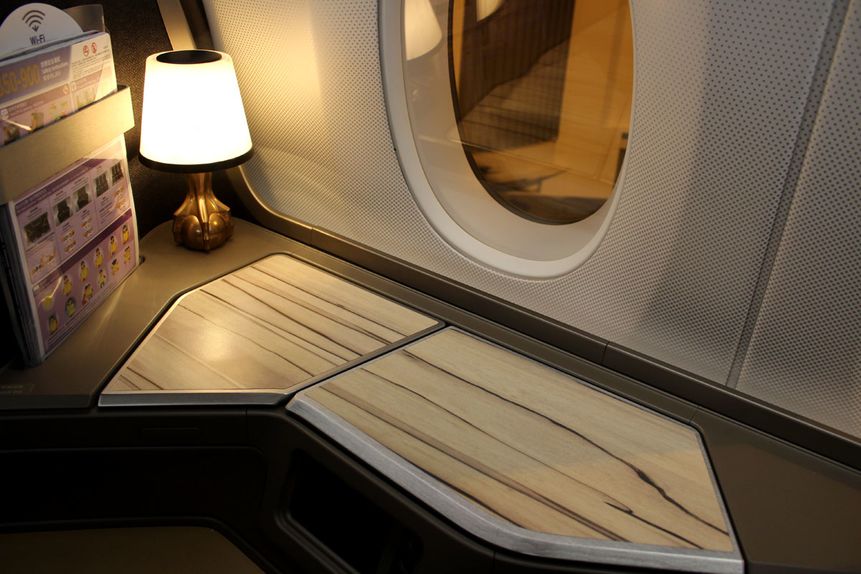
... where the compartments open to reveal two storage spaces: one being a smaller nook suitable for phones, passports, pens and landing cards, and the other initially housing your noise-cancelling headphones...
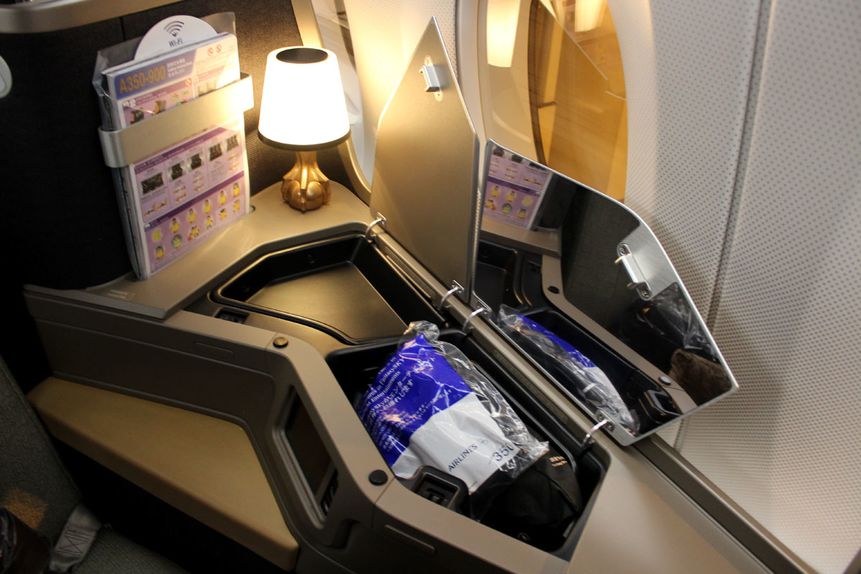
... and once taken out, you'll be able to access international AC power and a high-powered USB port for tablet charging, plus a touchscreen remote control for the inflight entertainment system if desired...
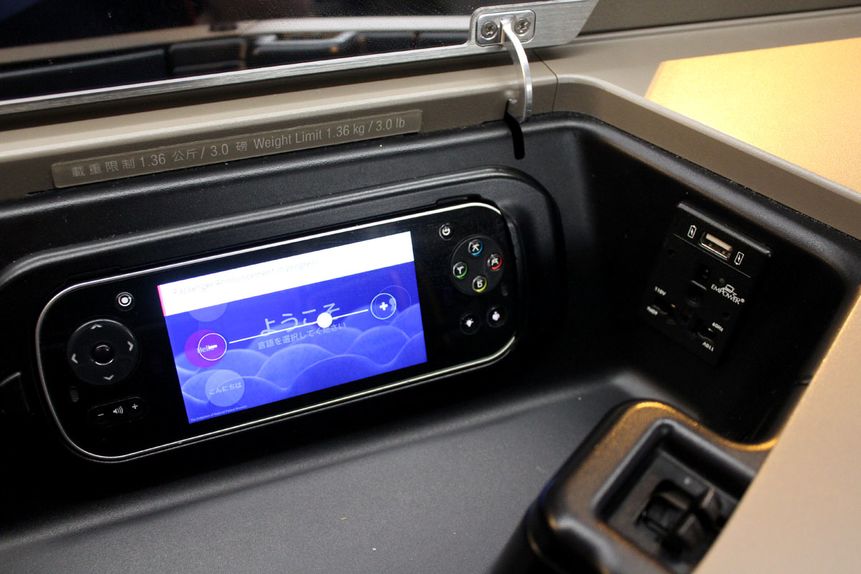
... and an additional USB port better-suited to charging smaller devices such as smartphones, plus the headphone outlet. While the supplied headphones were an acceptable quality, I was pleased that the airline adaptor for my own Bose QC35s fit easily into the same plug without any cables being squashed.
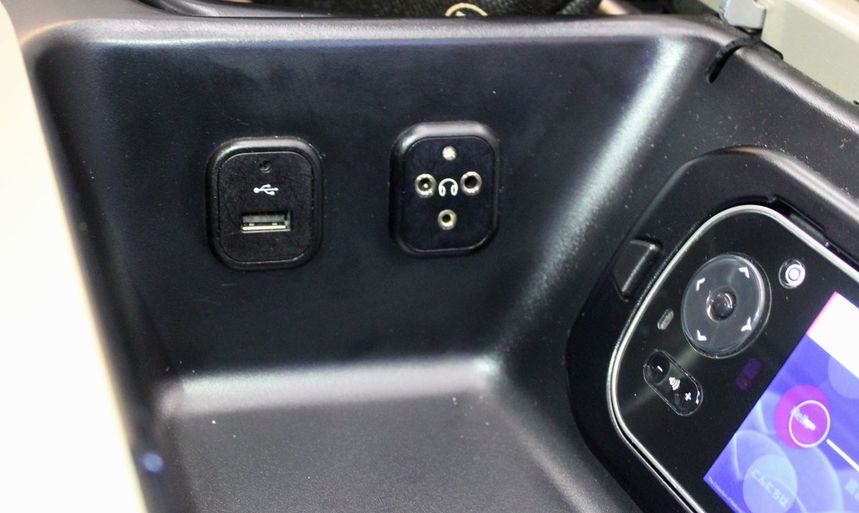
Speaking of cables, you don't need to leave the 'roof' open for cable access to those ports: there's plenty of space for these to pass through once the shelf on top has been secured closed, again without squashing those cables – useful if you're using your phone when charging, or watching a movie with headphones connected to the aircraft:
The larger of the two side panels also doubles as an inflight mirror when opened up:
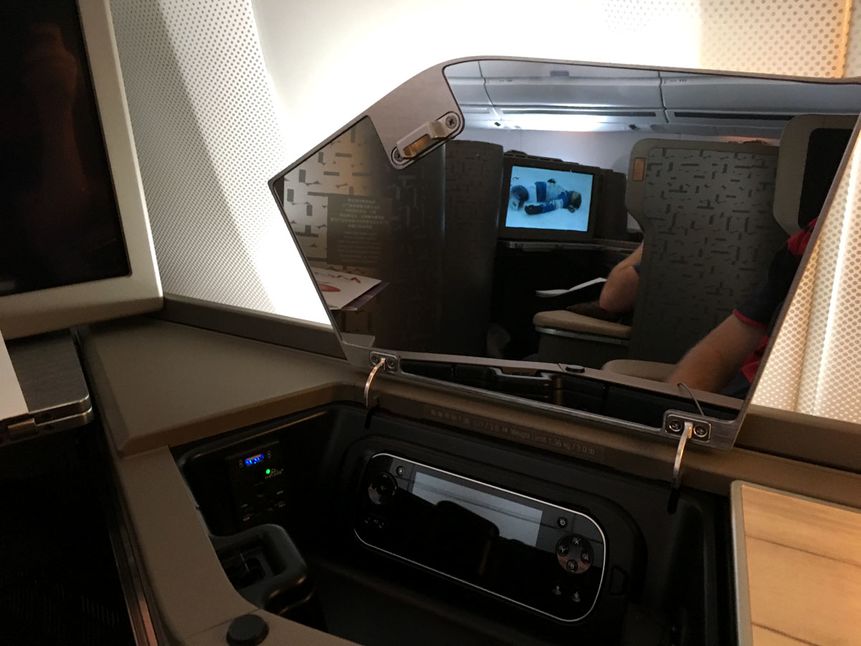
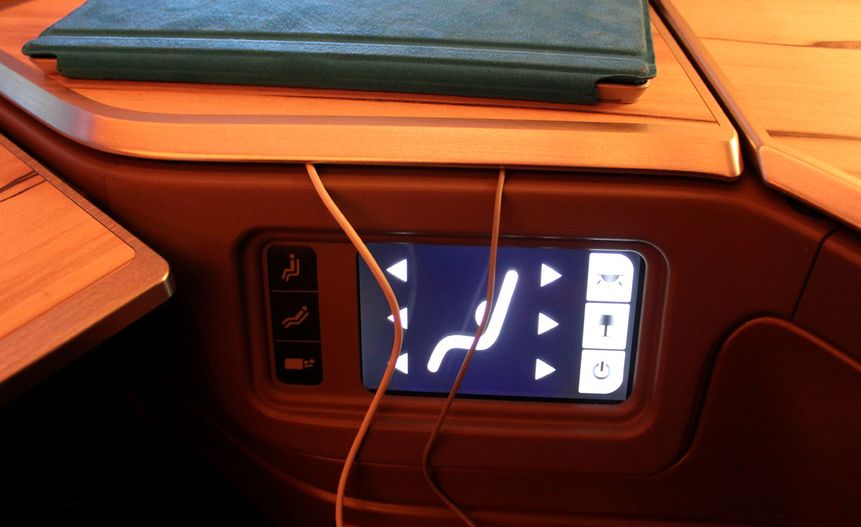
Just below that, a touchscreen controller for the seat itself, where you can activate or dim your side lamp, switch on the overhead light, and tweak the seat to your exact preferred position. The 'power' button allows you to instantly turn the screen off – useful if heading to sleep – while shortcut keys are available to the side both to save time during common stages of the flight such as relaxing, sleeping and landing, but which also provide a backup should the screen be proving difficult:
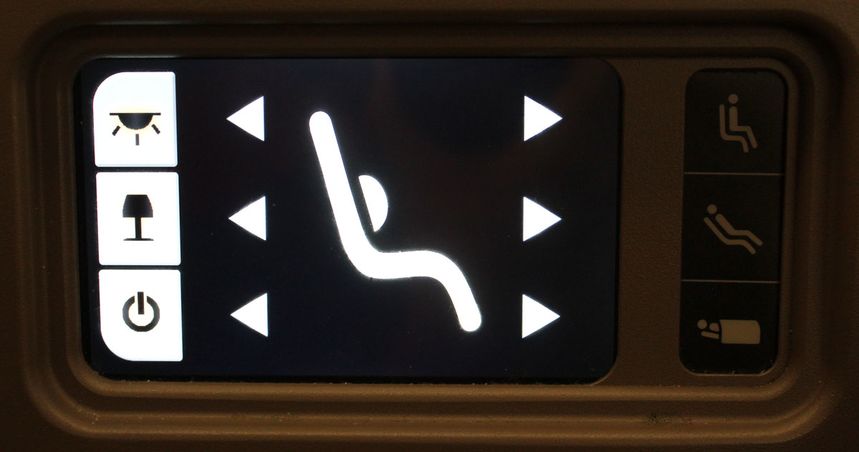
For example, on my flight from Taipei to London, this control screen was plain white upon boarding and wouldn't do anything. The crew were able to remotely reset the seat for me to fix the problem, but the side keys allowed me to adjust the chair in the meantime, avoiding the need to sit bolt upright while waiting for the software to reboot.
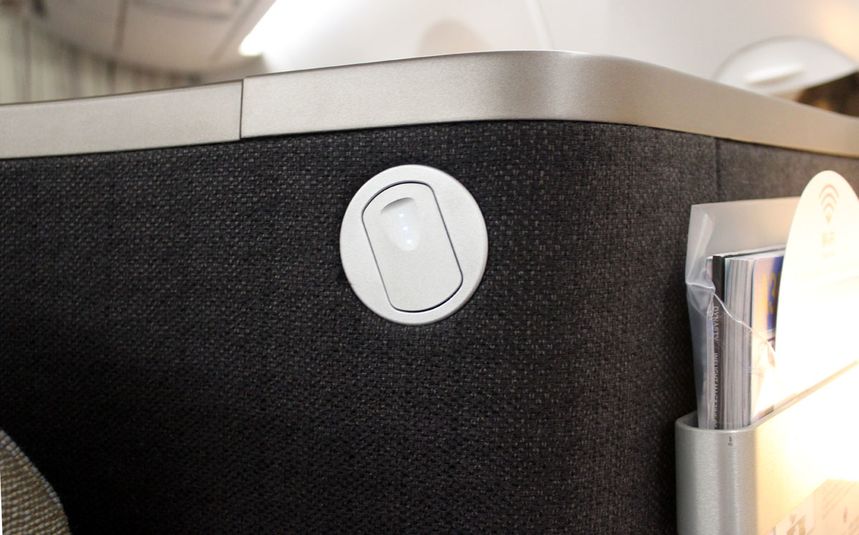
There's another light to your side built into the seat's shell, which pops out and swivels forward or backward to line up perfectly with your reading material (or inflight meal)...
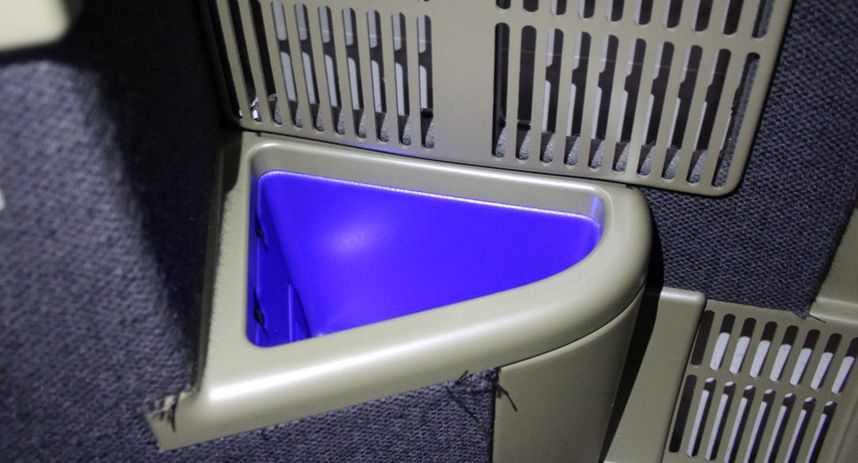
... and down near your feet sits a small storage nook useful for things like slippers (which China Airlines supplies), shoes, belts, and other bits...
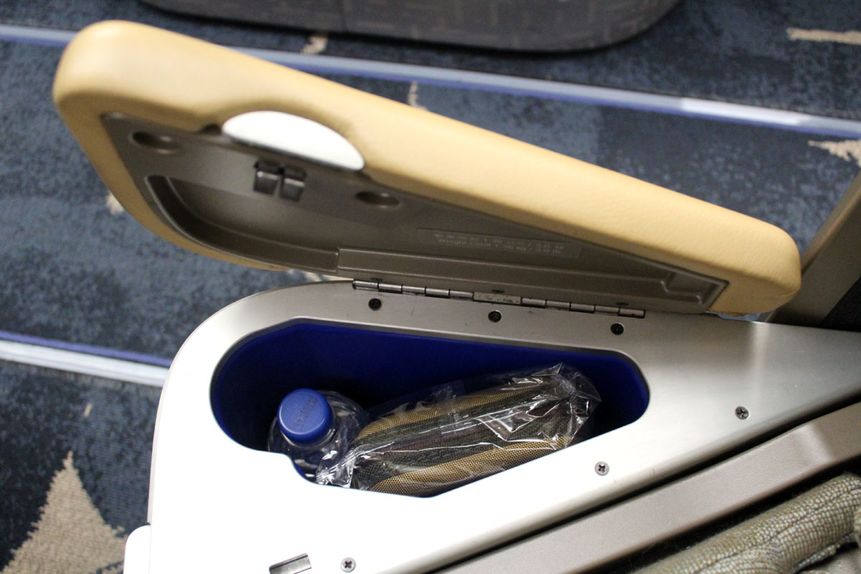
... while the armrest on the aisle-side of your seat houses a bottle of water and your amenity kit – but it's also large enough for things like headphones if you want to repurpose the space:
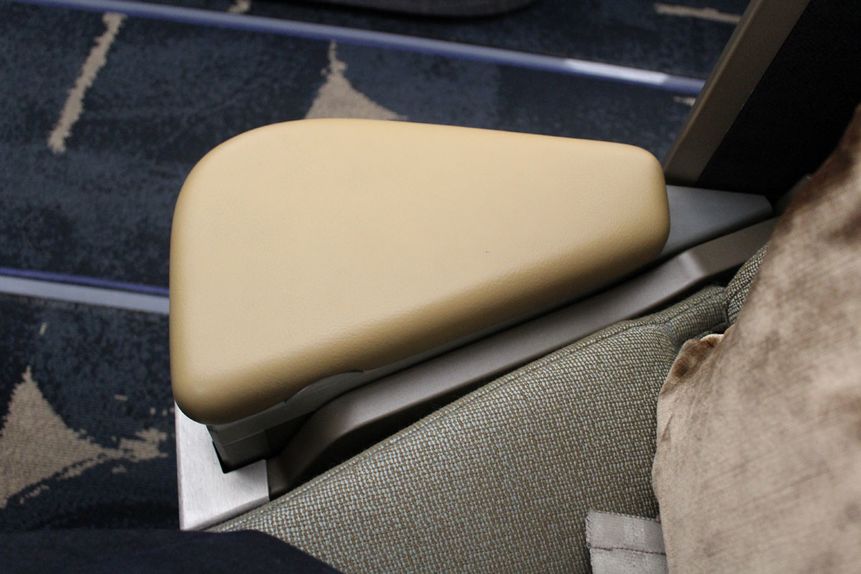
That armrest goes flat for take-off and landing, or if you're in bed mode and want a little extra elbow space...
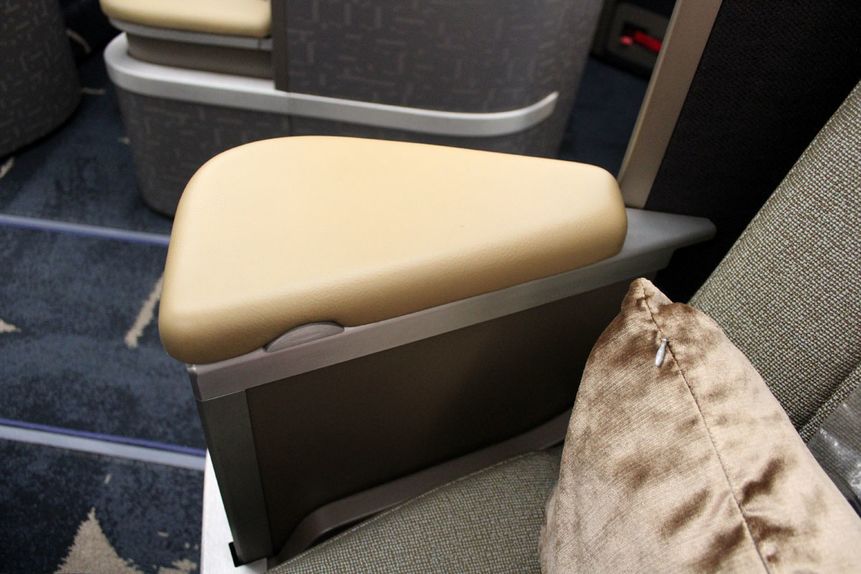
... but slides up for added comfort when desired. The height can be tailored to any position in between these two extremes as well, and firmly remains in the place you left it.
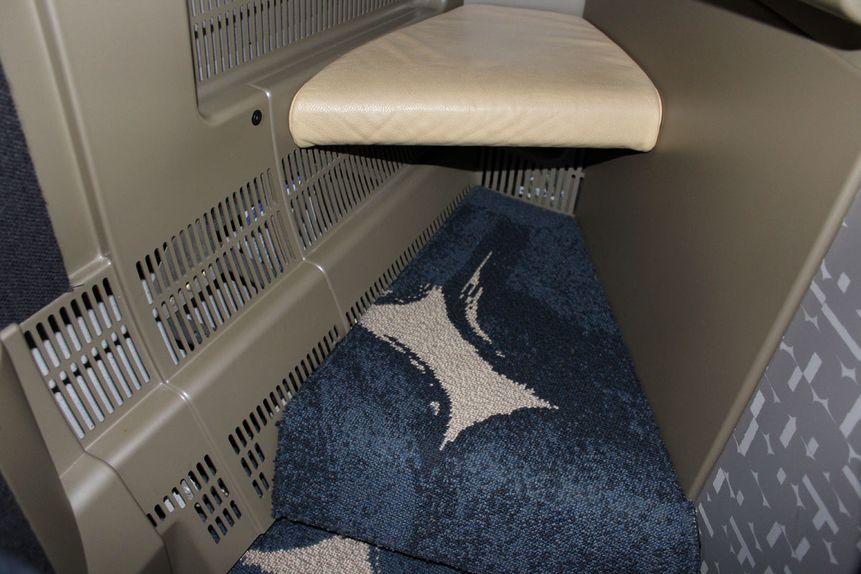
More storage is available underneath this fixed shelf, such as for your shoes, while the floor also tilts upwards here, allowing you to use the edge as a footrest before your seat is reclined, as the 'shelf' above isn't easily reachable until you've begun to lean back:
There's a coat hook for your jacket, although the crew will hang these for your in the closet during the flight...
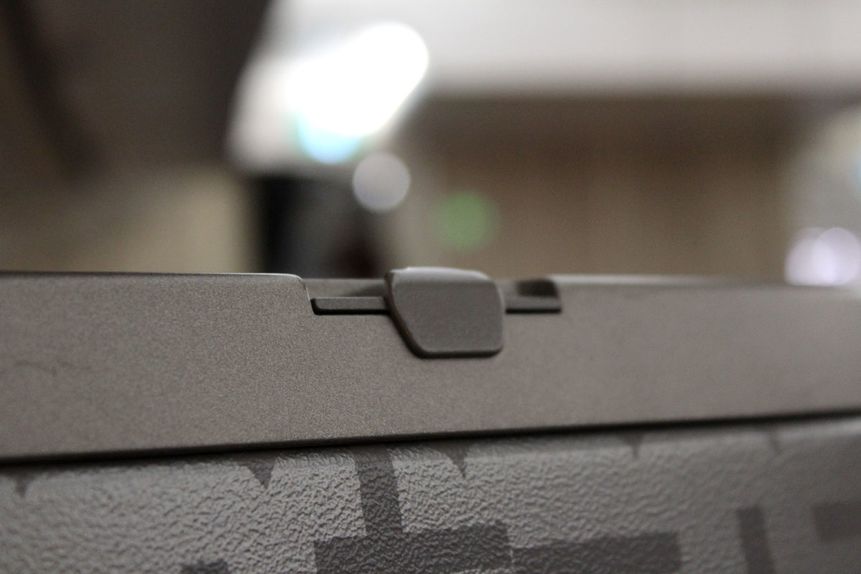
... and for meal times, or when working on a laptop, the tray table folds open with a design to match the rest of the cabin...
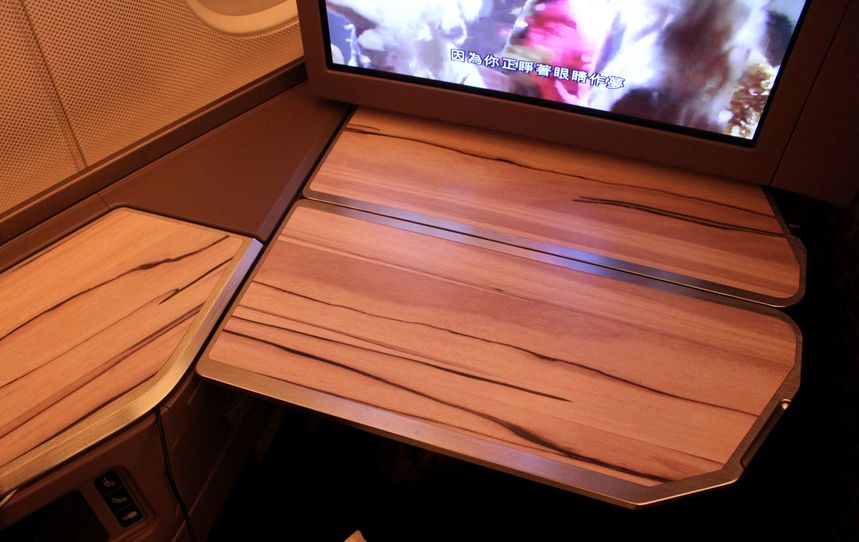
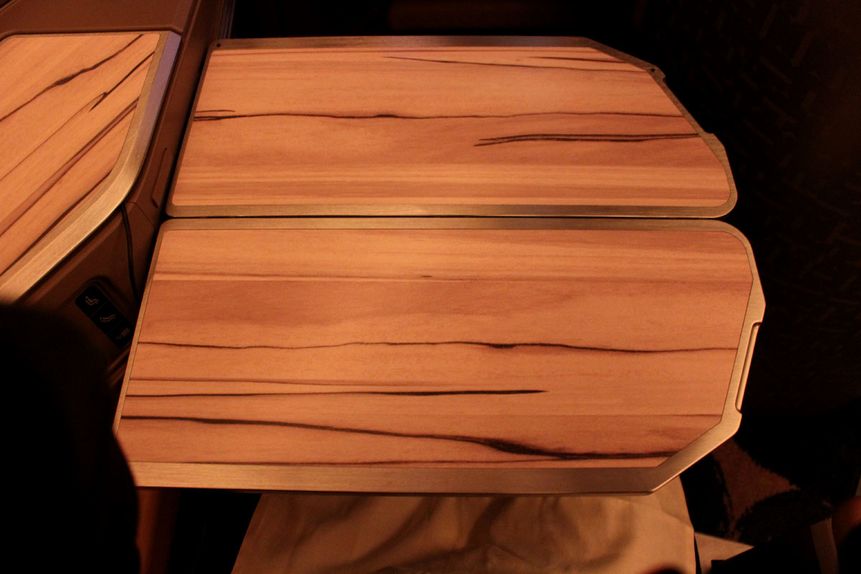
... and slides towards you, while also dropping slightly in height, which is more comfortable for typing and dining – but having the tray higher and further away from you is indeed useful for extra space when you're merely snacking or enjoying a drink:
When it's time to turn in, the seat itself transforms into a 198cm (78-inch) fully-flat bed, measuring at 71cm (28 inches) wide...
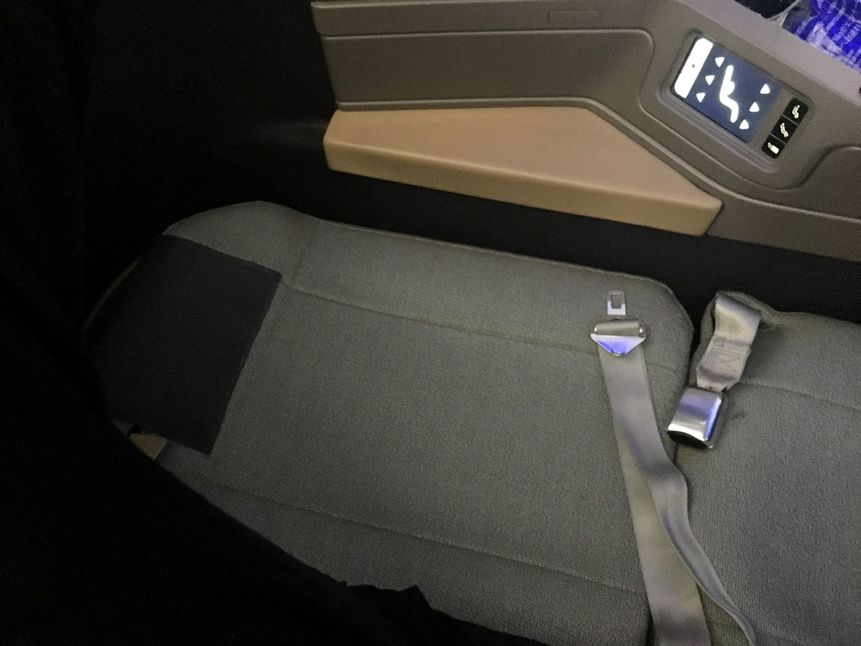
... but with every other detail of the seat so refined and finessed, this is where the product needs some improvement. For starters, the seat feels rock hard as a bed, and China Airlines provides no mattress cover to place on top to soften this.
My usual trick is to use the blanket as a fill-in mattress, but this made little difference – nor did tweaking the lumbar setting on the seat's control pad – and I found it tricky to get comfortable whether lying on my back or side:
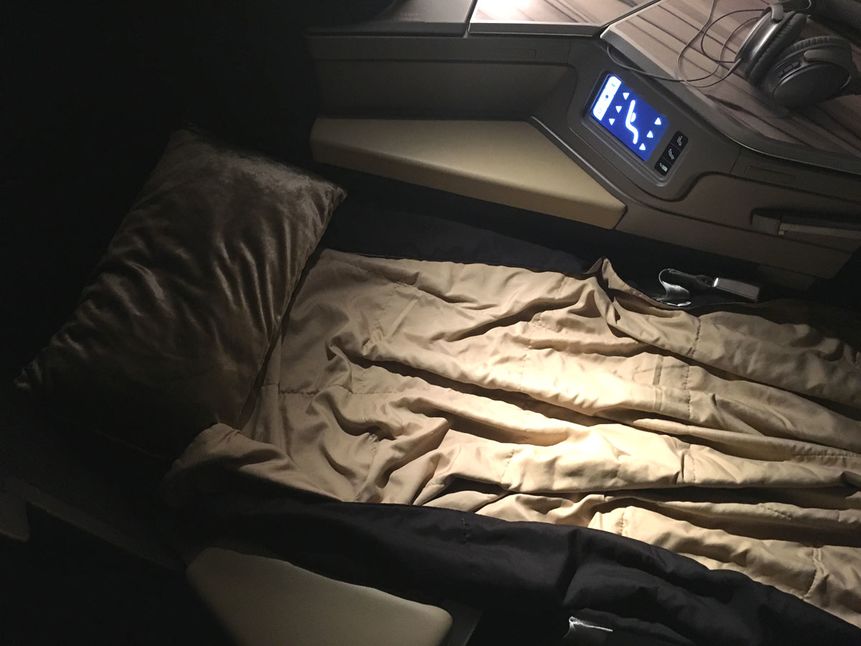
I also needed to use the seat's manual controls to tilt the upper section forward just a tad, as my head was ever-so-slightly below the level of my feet.
(Most business class seats these days recognise that aircraft don't fly parallel to the ground – they do so at a slightly elevated angle – so the 'default' seating positions are adjusted to offset this, making the traveller truly flat, but this hasn't been done here.)
That said, with most flights between Australia and Taipei running overnight, I got a solid sleep in both directions: eating on the ground and skipping the inflight meal service in favour of extra nap time, and was able to sleep when desired between Taipei and London, despite the tricky time differences: so sleep isn't difficult to achieve, it'd just be easier with a mattress pad on the seat to soften the surface.
Pyjamas, however, are BYO.
Meal
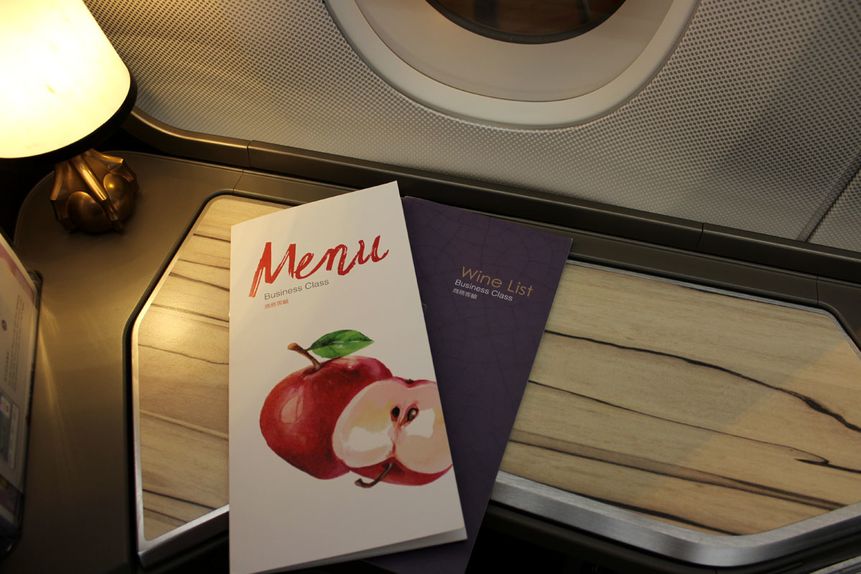
As the bulk of China Airlines' flights between Taipei and Sydney, Melbourne and Brisbane run overnight, most passengers won't get to experience the inflight meal service if intent on sleeping – but if you'd rather stay awake, there's a full menu and wine list to peruse:
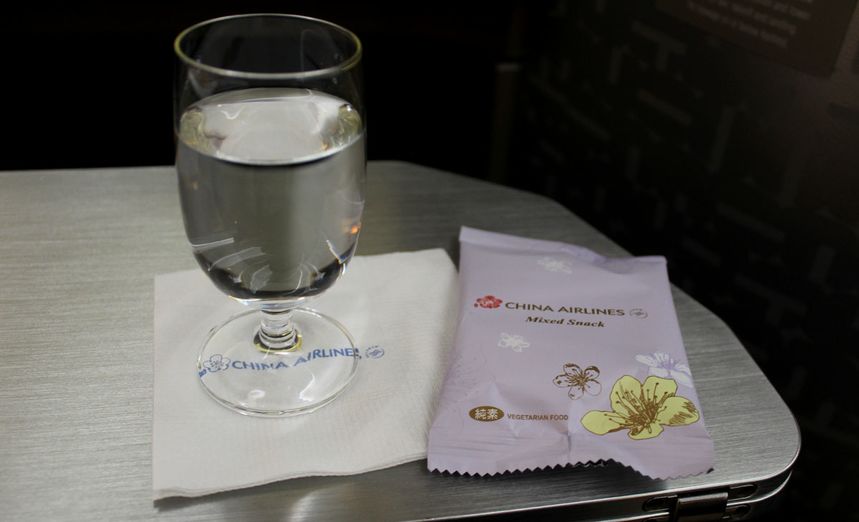
In any case, all journeys begin with a drink before take-off: typically only juice or water (alcohol isn't served until airborne), joined by a small snack bag:
Then on these overnight flights from Australia, there's a five-course dinner if you'd care to indulge, but having already eaten on the ground as most travellers would for a nine-hour flight departing near-midnight, I skipped this entirely on my Brisbane-Taipei leg, although the meal sequence was as follows:
- Starter: Peking duck slice with prawns and jellyfish
- Salad: Garden salad with balsamic vinaigrette
- Soup: Cream of mushroom soup with cheese straw
- Main: Braised pork belly, or Chinese salt-baked chicken thigh, or slow roasted beef cheek
- Dessert: Fruit and cheese plate, or caramel cake with raspberry coulis, or Serendipity ice cream
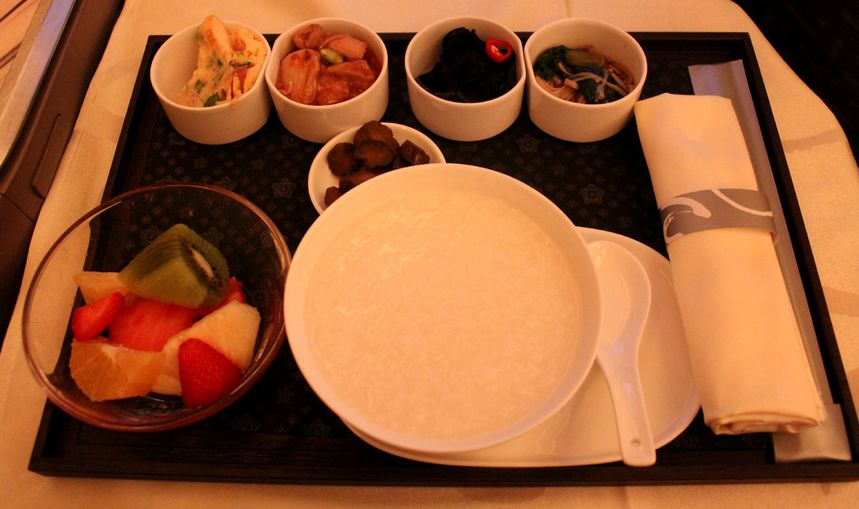
I awoke in time for breakfast, where travellers could choose either a Chinese or Western breakfast:
- Chinese: Plain congee with assortments: egg omelette with Chinese sausage, stir-fried chicken and bean curd with XO Sauce, marinated black fungus, shredded kale with enoki mushroom, pickles. Seasonal fresh fruit.
- Western: Mushroom omelette with Hollandaise sauce and potato Lyonnaise, plus bacon, spinach, cherry tomato, Bircher muesli, seasonal fresh fruit.
When flying with overseas-based airlines, I always enjoy trying their local food rather than the more familiar 'Western' dishes, and while not everything on the plate was to my personal taste, it was all very fresh:
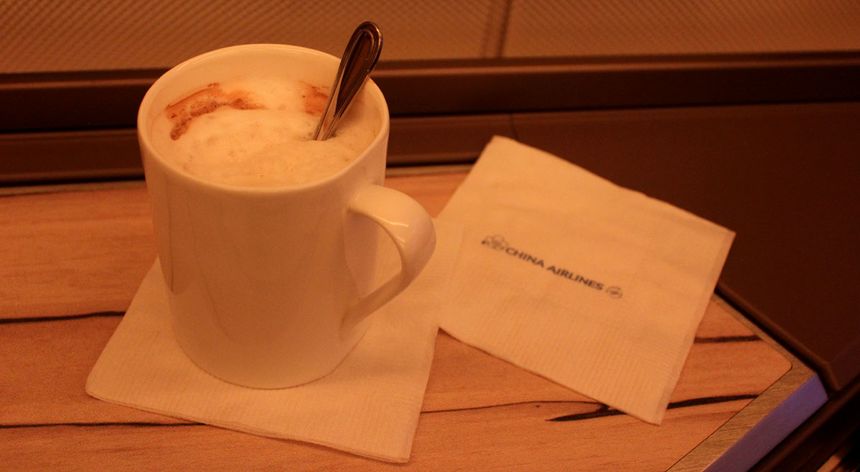
I also ordered up a quite acceptable latte, which the crew made using a Nespresso machine...
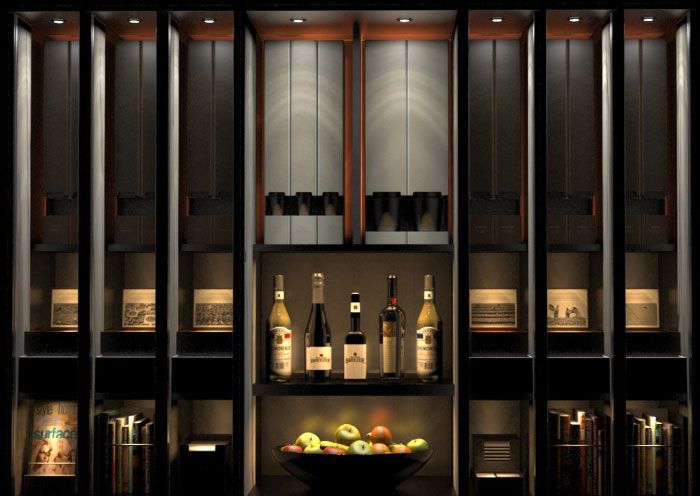
... and went for a wander to the rear galley for a look at the 'Sky Bar', shown here in this airline publicity shot as a refined space for grabbing drinks and snacks:
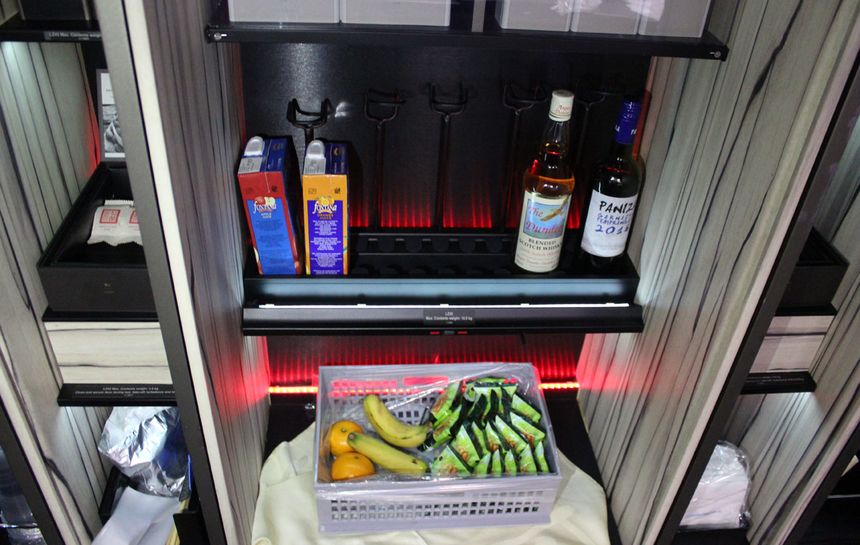
What awaited was less impressive, however, and more closely resembled a galley bench rather than an inflight bar – not just on this leg, but all other flights in this journey:
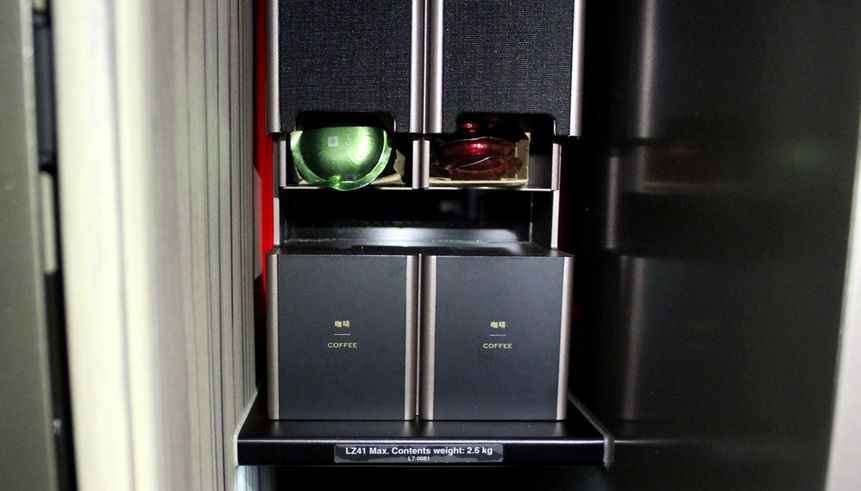
The bar did feature various Nespresso capsule types, however, so if you're a fussy Nespresso drinker or you'd prefer a decaf latte, the crew can certainly make this happen.
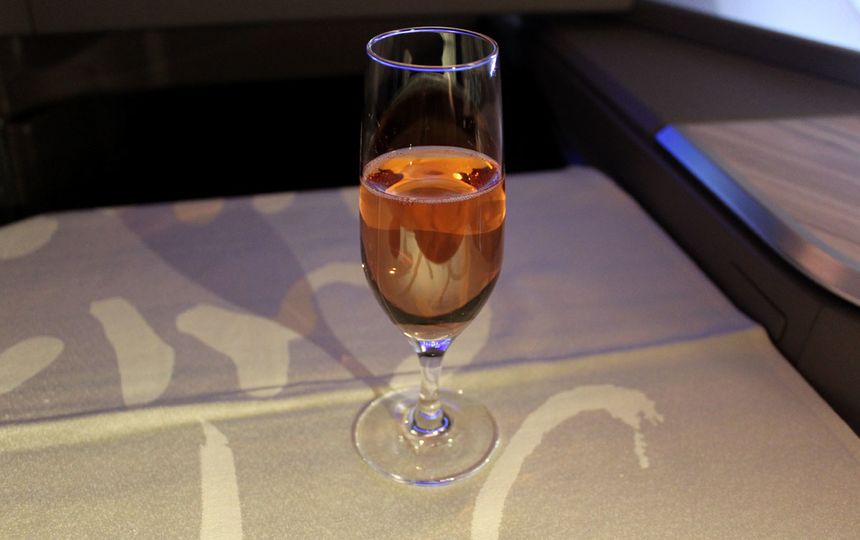
On the longer 14-hour flight from Taipei to London which runs entirely during the day, I had a better chance to sample the inflight dining, so my meal on this leg began with a glass of Pol Roger 2006 Vintage Rosé Champagne – a significant step up from the non-vintage Charles de Cazanove Brut poured on Australian routes:
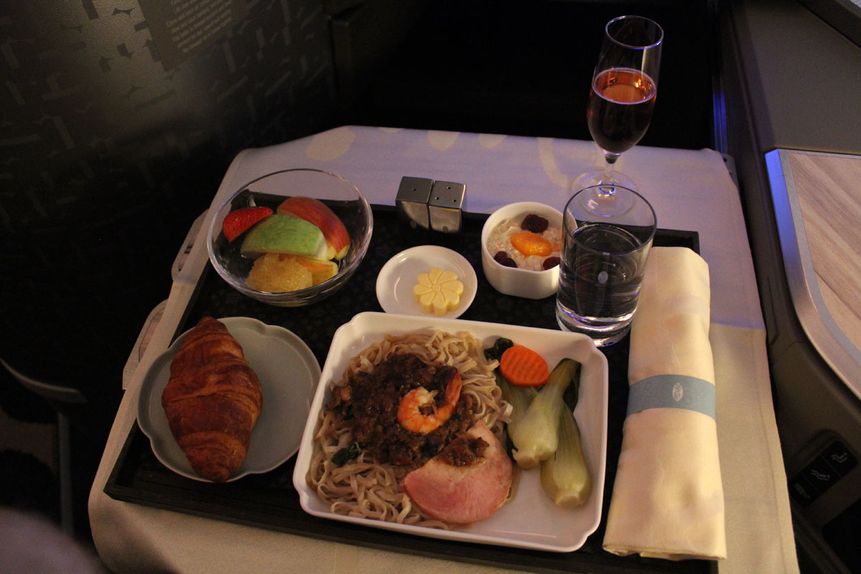
That continued with a mid-morning Chinese breakfast of prawn and minced pork in mushroom sauce over noodles with a pork slice, pak choi, fruit and Bircher muesli, which was a nice start to the day – the Western option being a spinach cheese quiche with breakfast vegetables and the same sides.
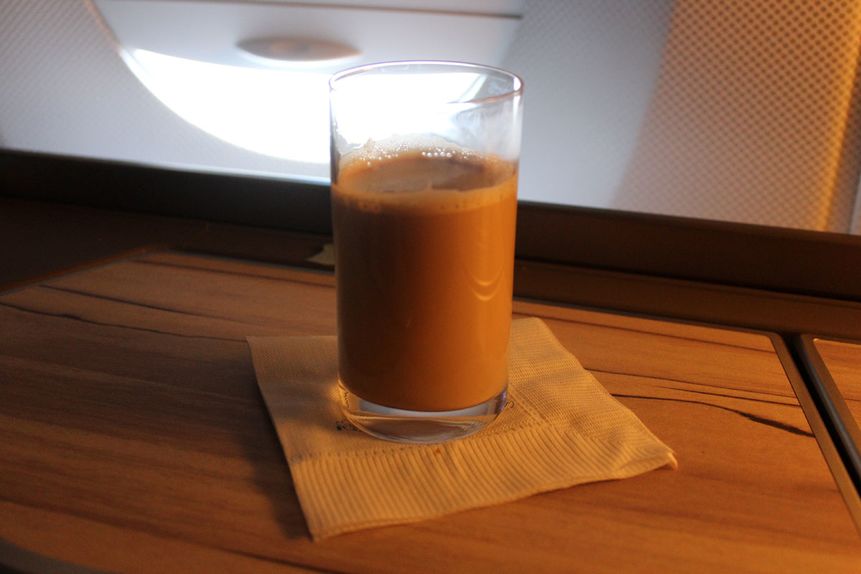
Afterwards, my usual latte, served this time in a glass and with much less froth...
... and having also eaten in the China Airlines lounge before this flight, I was set until later – but if I'd been hungry, I could have ordered some Taiwanese braised pork with rice as a mid-flight snack, with fresh fruit, chocolates and instant noodles also available outside the usual meal times.
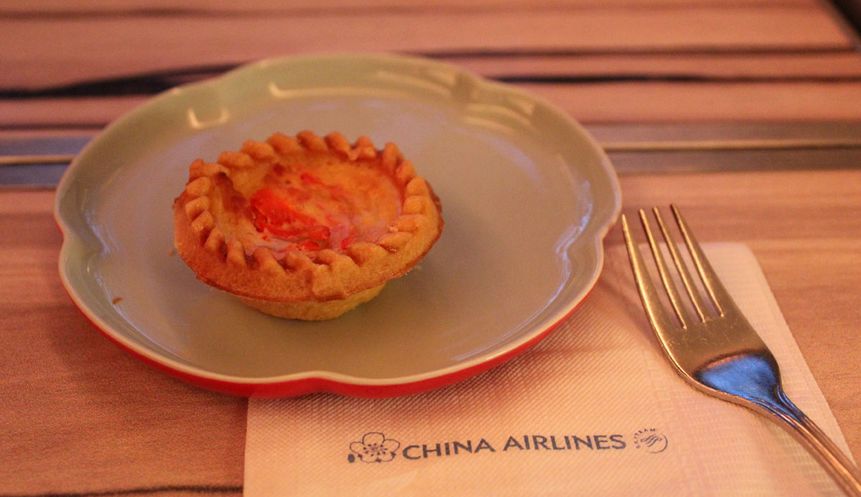
To prepare for the time zone differences with the late afternoon arrival in London, a multi-course lunch is served around half way through the flight, starting with a little bite in the Italian-style sausage and vegetable tart...
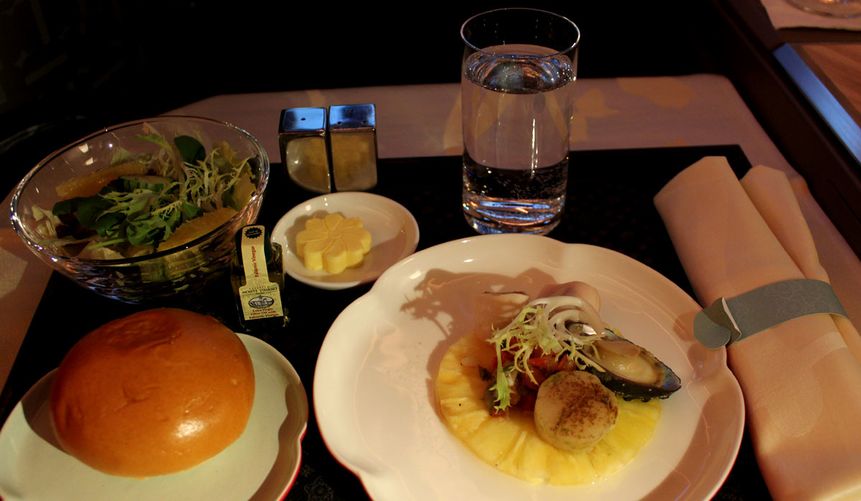
... continuing with a small garden salad with balsamic vinaigrette, and a starter of scallop and baby abalone with a smoked turkey apple roll, which was surprisingly tasty...
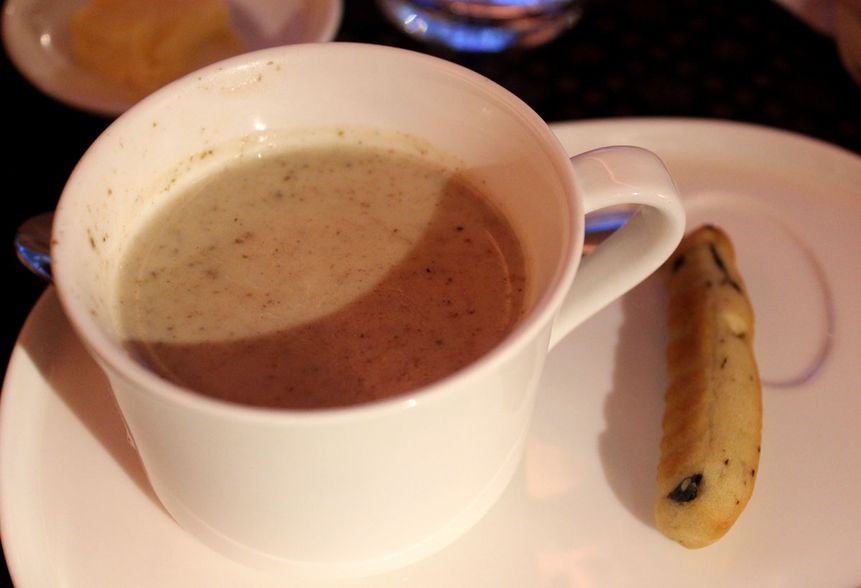
... progressing to a small cup of flavourful mushroom soup with an olive grissini...
... and then with a choice of main course:
- Mushroom-stuffed Taiwan free range chicken in soy sauce with steamed Dauho rice, plus braised eggplant with pumpkin, pak choi and carrot
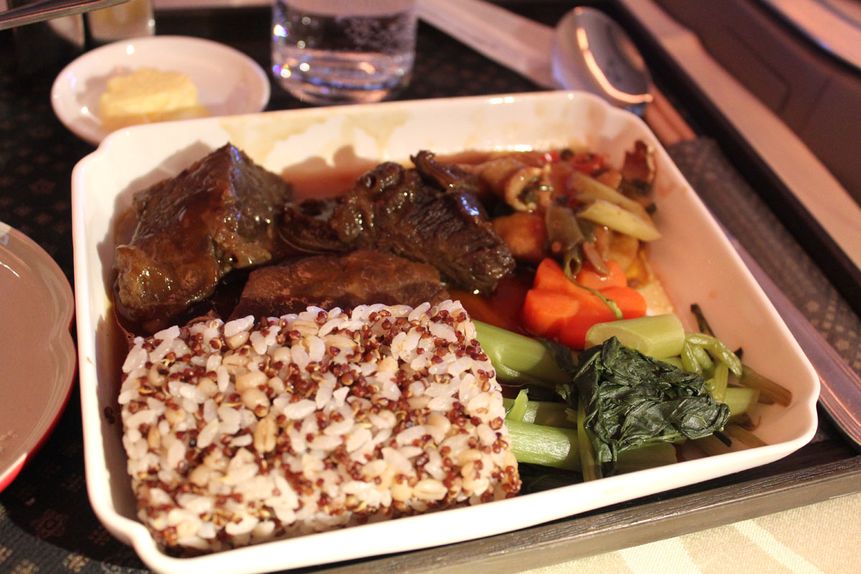
- Braised Panama beef cheek in brown sauce with steamed rice, mixed quinoa and barley, plus tofu in oyster sauce, kale a carrot
- Pan-seared white fish and cuttlefish ring with linguine spinach cream sauce and broccoli
I chose the beef, which had taken a long journey from Central America to Asia and then onward to London on this flight, so I was expecting it to be a little tough, but found it rather succulent.
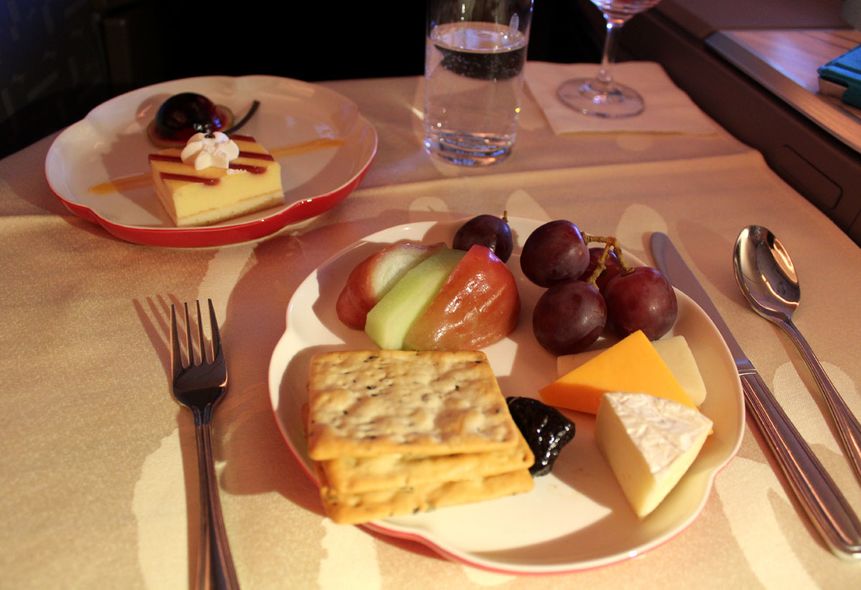
For dessert, a fruit and cheese plate with cheddar, brie and asiago, and a 'sweet duo' of raspberry cheese cake (yum) and a mixed berry white wine jelly (not-so-yum, unfortunately):
Items from the snack menu remain available for the rest of the flight if you get hungry – such as the pork rice – but eating earlier in the flight rather than closer to landing meant I was ready for dinner at around 8pm local time in London, helping adjust to the new time zone.
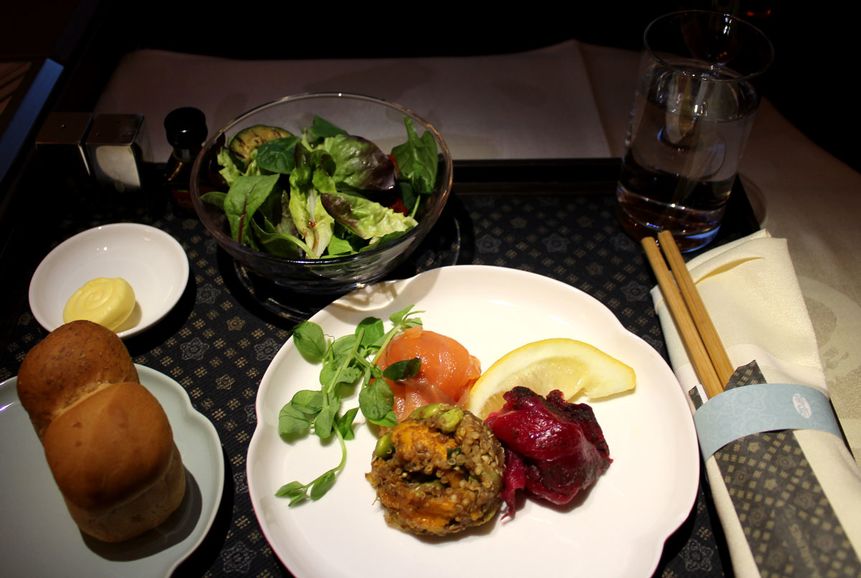
Fast-forward to the journey home from London to Taipei: CI70 departs mid-evening from Gatwick, so a late dinner is served onboard, beginning with a beetroot-cured smoked salmon rose with quinoa salad which was again fresh and tasty, with mixed leaves on the side...
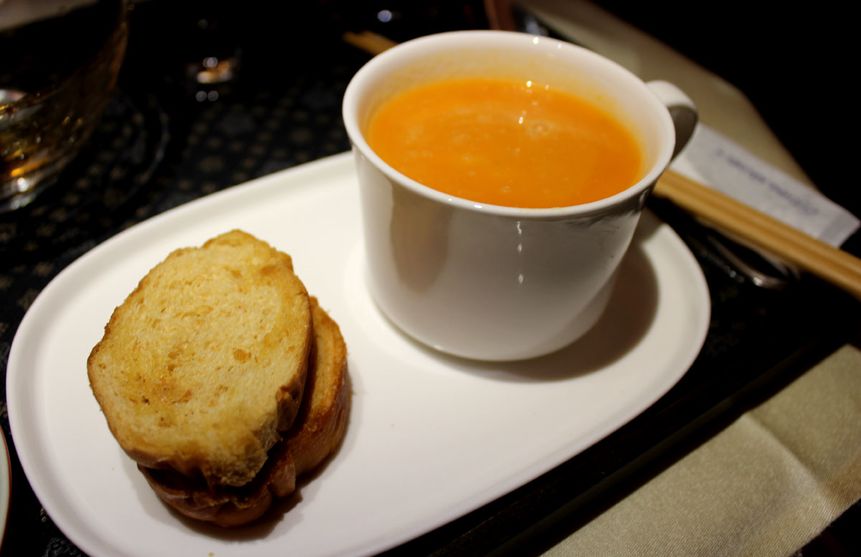
... followed by a smoked tomato soup with crostini...
... and then a choice of main course:
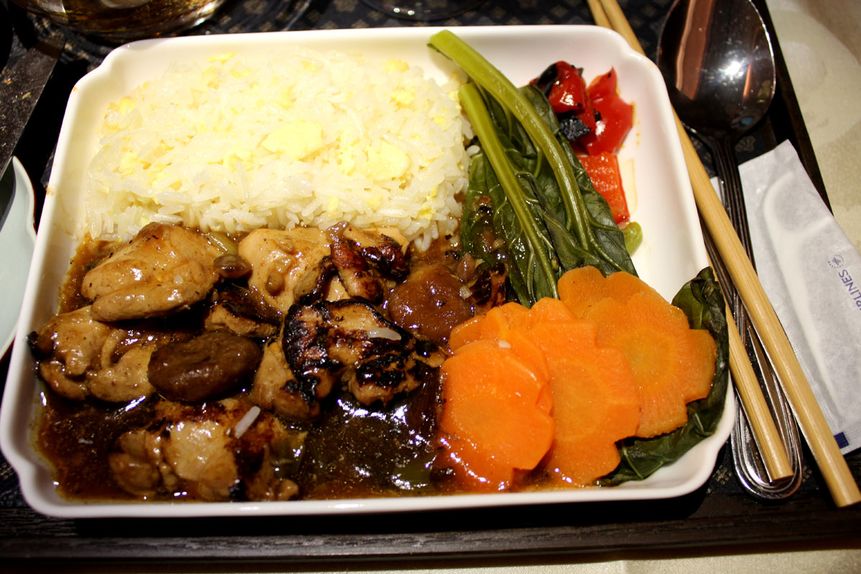
- Braised chicken and chestnut with egg fried rice, plus kale, carrot and red peppers
- Stewed pork belly in bean curd sauce with steamed rice, pak choi, mushroom and carrot
- Grilled beef fillet in Madeira truffle sauce with roasted new potatoes, vine cherry tomatoes and creamed spinach
Having tried other pork and beef dishes this trip, I went for the chicken and wasn't disappointed with it or the rice, although the sides were a bit predictable:
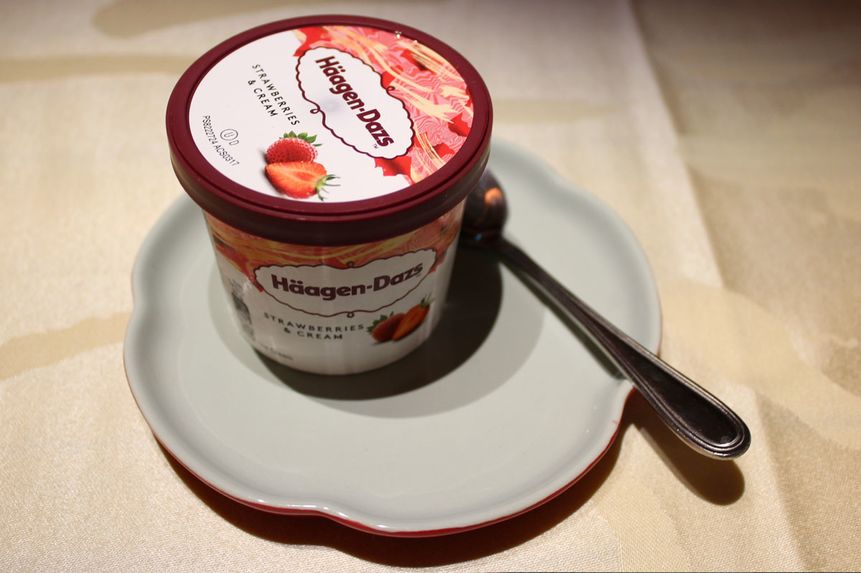
Similar cheese plates and desserts were offered as on the earlier flights, so I diverted to a simple serve of strawberries and cream Haagen-Dazs to finish off:
Unlike on the Taipei-London leg where the second meal is served half way through the flight, from London to Taipei, breakfast is instead served around two hours before landing, allowing you get some solid sleep on what is a night-time leg, despite the 6pm arrival into Taiwan.
This time, the Chinese breakfast offered a choice between plain congee or char siu pork with stir-fried egg noodles – I chose the latter and quite enjoyed it, and although the salty egg on the side is quite a simple option, found that a nice bite, too.
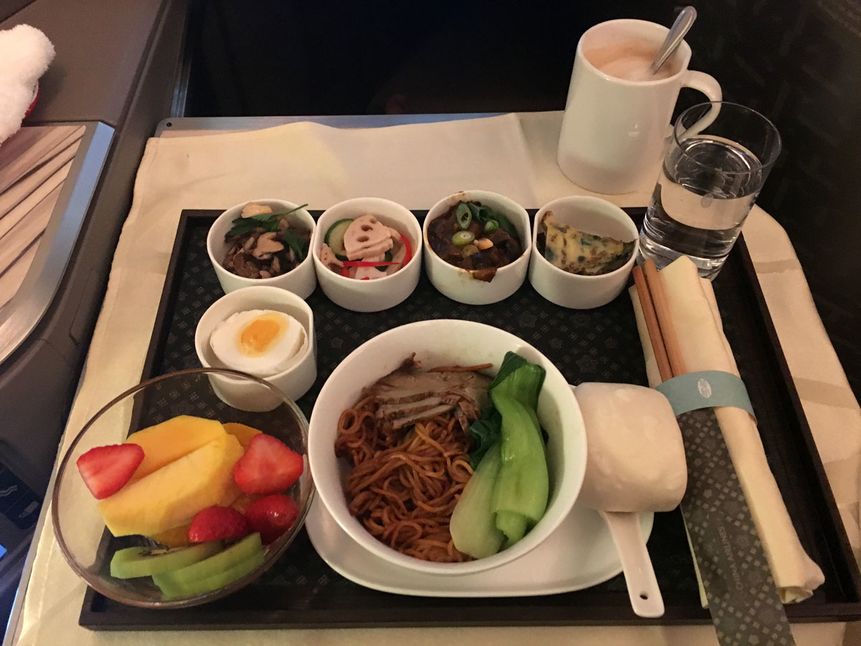
The Western option offered a mushroom omelette instead – similar, but not identical to the Western breakfast dish on my Brisbane-Taipei flight, so if you'd rather stick to Western foods on these flights, you won't have much variety.
Most flights onward from Taipei to Sydney, Melbourne and Brisbane depart around midnight in Taiwan (2am AEST), so I again chose to eat before the flight and skip the inflight service entirely in favour of sleep.
If you're spending the day in Taipei before heading to the airport and want to maximise your rest (while also skipping yet another inflight meal), I'd recommend checking out Hawker Chan in the Taipei 101 food hall instead: the world's first Michelin-starred hawker stand, where its signature soya sauce chicken dish – which earned that star – can be enjoyed for just A$5.35.
If you'd rather eat on board, the Taipei-Brisbane menu was as follows for dinner:
- Starter: Smoked duck breast and blanched prawns with okra and purple sweet potatoes
- Salad: Garden salad with balsamic vinaigrette
- Soup: Mushroom soup with olive grissini
- Main: Stewed chicken thigh and steamed liver sausage, or stewed pork in red fermented bean paste with jade rice, or pan-seared white fish and cuttlefish ring with linguine spinach cream sauce
- Dessert: Fruit and cheese plate, or sweet duo (cheesecake and jelly), or ice cream
Breakfast is served three hours before landing in Brisbane – not great if the lights wake you up – and these options were:
- Chinese: Plain congee with assorted accompaniments
- Western: Cheese and mushroom omelette and smoked pork loin with pan-fried Polenta cake
I chose to sleep through until half an hour before landing, which gave me enough time to get dressed and enjoy a latte before having a meal at home.
Entertainment & Service
On the entertainment front, each business class seat offers an 18-inch personal HD touchscreen, loaded with movies, music, games and TV shows:
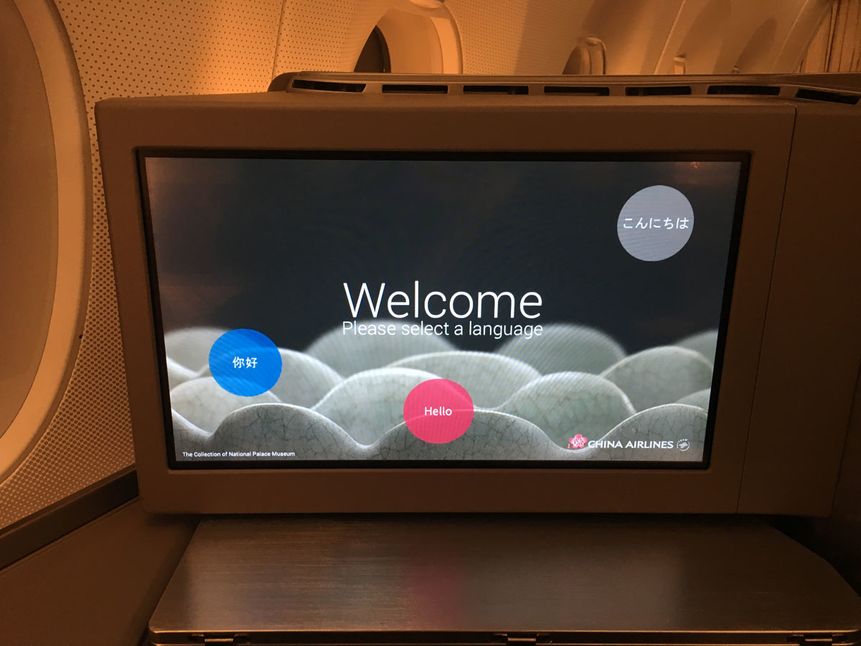
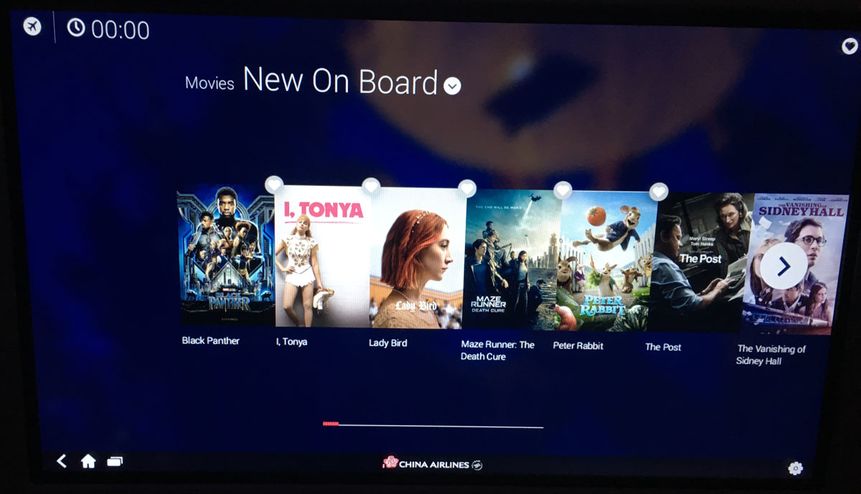
I found the broader selections rather slim – the absence of a 'comedy' category was odd, too – although there were plenty of new release movies and this collection grew before the journey home from London, which kicked off after the start of a new month:
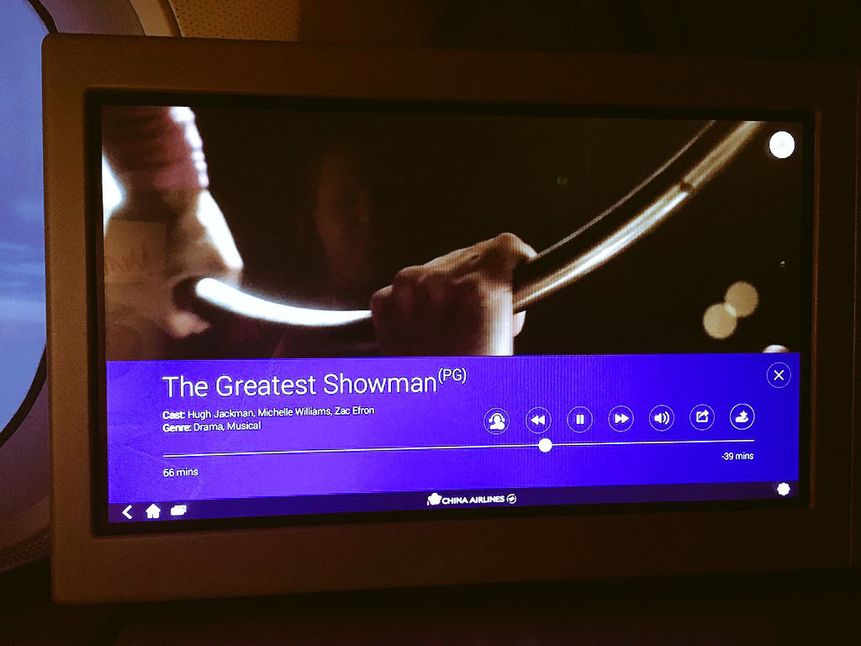
My personal pick from the bunch would be The Greatest Showman, which I ended up watching several times because the songs were so catchy...
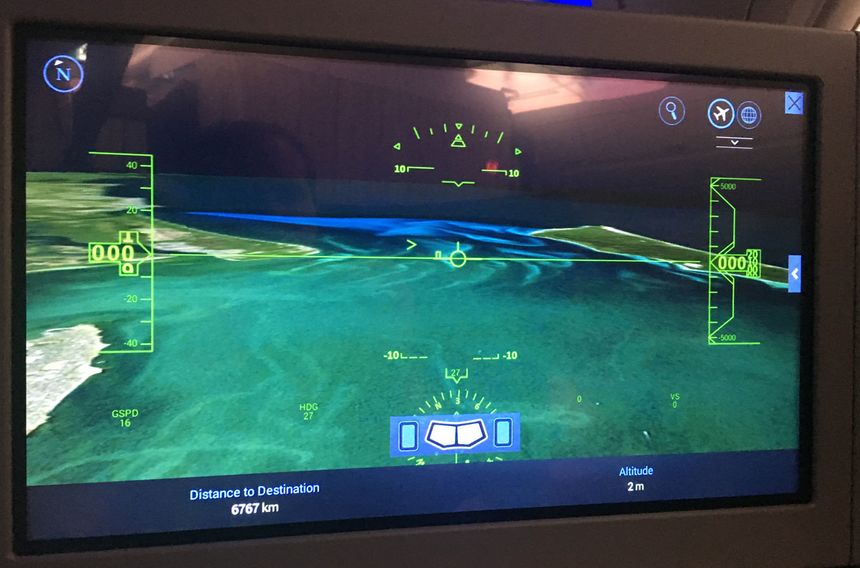
... while the 'moving map' on these aircraft is much more sophisticated than on many other planes, including a CGI 'cockpit mode' where you can see what the pilots are seeing, including a heads-up display – although the instruments were delayed from real-time, and there was no access to the A350's external aircraft cameras:
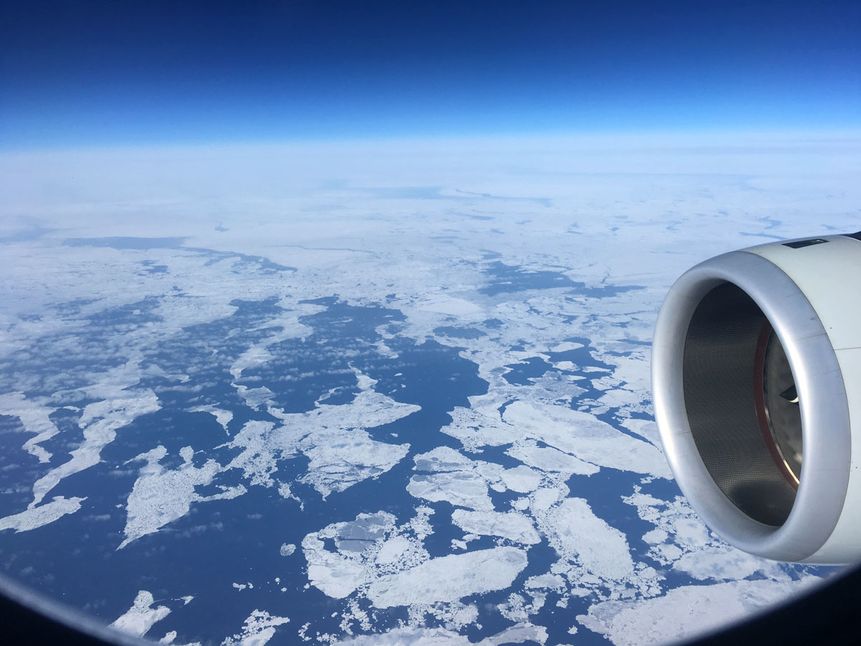
There's inflight Internet access too, but a source of entertainment also came when flying over far north Russia on the Taipei-London leg, where I happened to open my window at the perfect moment:
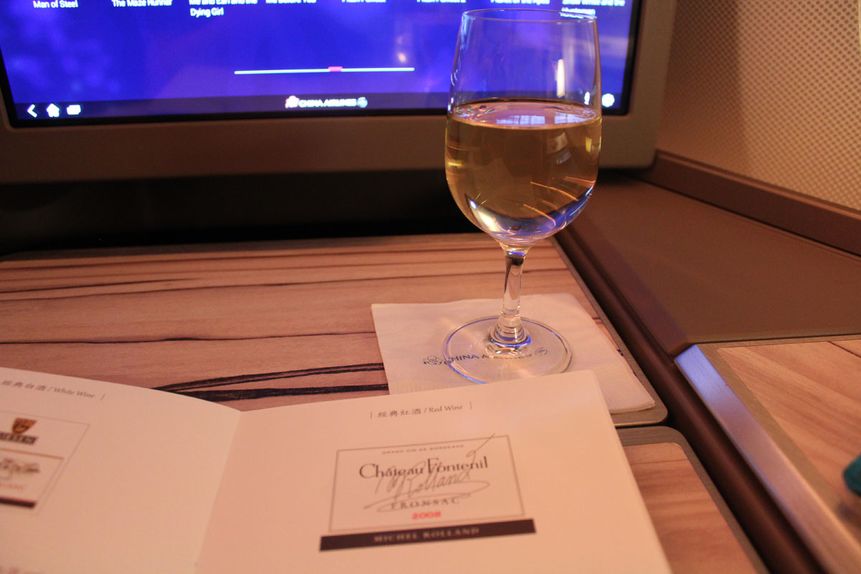
Service-wise, all crew members could speak English and cabin announcements were made in English, but a few things were lost in translation: such as when ordering the "red wine" from the menu, and receiving this instead, albeit still a nice drop:
Overall though, the experience with China Airlines was better than I'd expected in most ways, with a modern aircraft, stylish cabin, reasonable inflight dining and vintage Champagne on London flights, but could be improved in other areas.
For example, the inflight menus on each leg weren't particularly different to the flight before it, with many of the same dishes appearing multiple times throughout the journey.
The range of entertainment content could also be expanded, and of course, a mattress pad or topper for the seat wouldn't go astray.
Yet, with China Airlines often selling return business class fares between Australia and London for just $4,000-5,000 (compared to $6,000-$12,000 with most other airlines), this is a great-value choice for your next long-haul trip – or even your next trans-Tasman journey, with daily A350 flights now running between Brisbane and Auckland, too.
Chris Chamberlin travelled to London as a guest of China Airlines.