
Revealed: Marriott's new mega hotel loyalty program
Marriott has taken the next big step to align its three hotel loyalty programs into one, revealing the details of what will become the brand’s single loyalty program, merging members from Marriott Rewards, Starwood Preferred Guest and Ritz-Carlton Rewards.
The new scheme still doesn’t have a name, and those three existing programs will stick around until the end of the year – but from August 2018, members of all three will be able to merge their accounts together, including all their points and elite nights, using the one new program at every hotel.
For example, a traveller staying at a Sheraton hotel can only currently earn points and status with SPG, while a guest staying at a Marriott hotel can only use Marriott Rewards. From August, the one loyalty program will cover both hotels, and all other brands, too.
Here’s what’s changing across the board, and how it affects you, the business traveller.
Your status will be matched in the new program
If you already hold a shiny membership card with Marriott Rewards, Starwood Preferred Guest or Ritz-Carlton Rewards, your status will be aligned to a comparable tier in the new program.
For Marriott Rewards and Ritz-Carlton Rewards Gold members, that means a bump to Platinum Elite under the new scheme, while existing Platinum members will be elevated to Platinum Premier Elite.
Current Platinum cardholders who have also stayed for 100 nights across all three loyalty programs this year and have spent at least US$20,000 at hotels will instead be recognised with both Platinum Premier Elite status and Ambassador service, for more personalised travel assistance.
Silver-tier members will either be offered Silver Elite or Gold Elite under the new program, depending on how many nights they’ve spent at hotels – the former offered for members having stayed 10-24 nights, and the latter for those having stayed 25-49 nights.
From Starwood Preferred Guest (SPG), the alignment works a little differently. SPG Gold members will be given Gold Elite and SPG Platinum members will be Platinum Elite under the new program.
SPG Platinum members with 75 nights under their belt will instead be recognised with Platinum Premier Elite under the new scheme, and SPG Platinum members with 100 nights will be offered Platinum Premier Elite with Ambassador service.
Because SPG doesn’t currently have a Silver tier, entry-level members who have stayed 10-24 nights will receive Silver Elite under the new system – as will members with SPG Corporate Preferred Guest and Preferred Guest Plus memberships.
What about Lifetime status?
If you’ve already achieved Lifetime status in one of the programs, you’ll be recognised as a Lifetime member in the new scheme too, with SPG Lifetime Gold unlocking Lifetime Gold Elite and SPG Lifetime Platinum providing Lifetime Platinum Elite under the new system.
Similarly, Marriott Lifetime Silver members will be brought across to the Lifetime Silver Elite tier, although Marriott Lifetime Gold members will shoot up to Lifetime Platinum Elite in the new program. Marriott Lifetime Platinum cardholders will instead enjoy Lifetime Platinum Premier Elite in the new program: the highest tier.
Currently on the path to earning Lifetime status but not quite there yet?
The new program will allow members to qualify for Lifetime Silver after 250 nights and five years of elite status, Lifetime Gold after 400 nights and seven years of status at a Gold tier or higher, and Lifetime Platinum after 600 nights and 10 years of Platinum-level status.
Overall, that’s good news for Marriott Rewards loyalists who currently need 500 nights and 1.6 million points for Lifetime Gold or 750 nights and two million points under the current program, but for SPG members, it makes Lifetime status harder to achieve.
That’s because you can currently snag SPG Lifetime Gold after just 250 nights with five years of elite status: but staying for that same period under the new program would only give Lifetime Silver. SPG Lifetime Platinum can also currently be earned after 500 nights and 10 years of membership, so the new rules would mean staying for an extra 100 nights to reach the same tier.
To ease the blow for members who are close to one of the existing Lifetime thresholds, members will be able to qualify for Lifetime status based on the existing or the new rules until the end of 2018 – whichever proves more favourable for you – but from 2019, only the new thresholds will apply.
Also note that when merging your Marriott Rewards, Ritz-Carlton Rewards and SPG accounts together, all of your current Lifetime nights will be pooled into the one basket: so if you’ve spent 150 nights at SPG hotels, 50 nights with Marriott and 50 nights with Ritz-Carlton with five years of elite status under your belt, you’ll immediately receive Lifetime Silver in the new program.
Lifetime Platinum Premier Elite status cannot be ‘earned’ under the new program – it’s exclusively for existing Marriott Lifetime Platinum members.
Earning status in the new, combined program
With all three programs combined, members will be able to earn status by staying at any participating hotel across the entire Marriott, Starwood and Ritz-Carlton portfolio.
Here are the new program tiers, and how you can reach each one:
- Silver Elite: Stay for 10 nights in a calendar year
- Gold Elite: Stay for 25 nights in a calendar year
- Platinum Elite: Stay for 50 nights in a calendar year
- Platinum Premier Elite: Stay for 75 nights in a calendar year
- Platinum Premier Elite with Ambassador: Stay for 100 nights in a calendar year with a cumulative spend of US$20,000
This aligns with the way Starwood Preferred Guest members currently earn status, although the ability to qualify based on ‘stays’ rather than ‘nights’ is not being carried over, which impacts frequent travellers who stay for just one night at a time.
The Ambassador level in the current SPG program also doesn’t require a minimum spend, with the new requirement pegging this at an average spend of US$200 (A$256) per night.
Benefits of status in the new program
Once you’ve ironed out your status level, here are the main perks you’ll unlock as you progress through each level – so if you’re Gold, you’ll enjoy all the perks of Silver and your boosted perks at Gold, for example, except for the points bonus which is one per tier only:
- Member (entry-level): Free in-room Internet access
- Silver Elite: 10% points bonus, late check-out as available
- Gold Elite: 25% points bonus, welcome gift of points, standard room upgrade and late check-out to 2pm, both subject to availability
- Platinum Elite: 50% points bonus; welcome gift of points, breakfast or local amenity; space-available room upgrades include suites, hotel lounge access and 4pm late check-out (where available), plus five bonus suite night awards
- Platinum Premier Elite: 75% points bonus, plus five extra suite night awards, being 10 in total for the year including those received at the Platinum Elite level
- Platinum Premier Elite with Ambassador: Ambassador service and access to Your24, which allows you to check-out 24 hours after arriving at the hotel at no extra cost – so if you arrive at 9pm one day, you can depart at 9pm the next day while paying only for one room night.
While balanced overall and more broadly aligning with many of the existing benefits of the Marriott Rewards program, these new benefits do pare back some of the perks for current SPG Gold and Platinum 75-night members.
For example, SPG Gold members currently enjoy a guaranteed 4pm late check-out at most hotels – under the new system, that’s wound back to 2pm subject to availability at the equivalent tier. The option of a free drink on arrival will be axed, with bonus points the only available arrival gift.
Regular SPG Platinum members get access to practically the same benefits under the new scheme, but SPG Platinum 75-night members will lose ‘Your24’, becoming exclusive to top-tier members under the new program who spend 100 nights and US$20,000/year at hotels.
What about earning points under the new program?
Currently, members earn points across the three separate programs depending on where they stay, but under the new program, points will be earned in a single currency in the one program.
The earn rate across all hotels will become a universal 10 points per US$1 spent, except at Residence Inn, TownePlace Suites and Element, which will provide 5 points per US$1 spent. Status bonuses indicated above will be calculated on these base rates.
Your existing points balances will also be pooled to a single new account, at a rate of 1:1 from Ritz-Carlton Rewards and Marriott Rewards, and 1:3 from SPG – that’s three reward points under the new system for every one Starpoint in your SPG account when it’s merged.
For example, if you currently have 60,000 Marriott Rewards points and 100,000 Starpoints, your 60,000 Marriott points would be brought across as 60,000 points in the new program, and your 100,000 Starpoints would become 300,000 points with the new system, giving you a combined balance of 360,000 reward points.
Redeeming reward points for hotel stays under the new program
Members will continue to be able to use points to book hotel stays under the new system, with a single Free Night Award chart covering the entire hotel portfolio from August 2018, with a single rate for each hotel and each property assigned a Category number from 1 to 7.
From 2019, there’ll be a new Category 8 for high-end properties, and the number of points needed to book all hotels will vary slightly during peak and off-peak periods, as below.
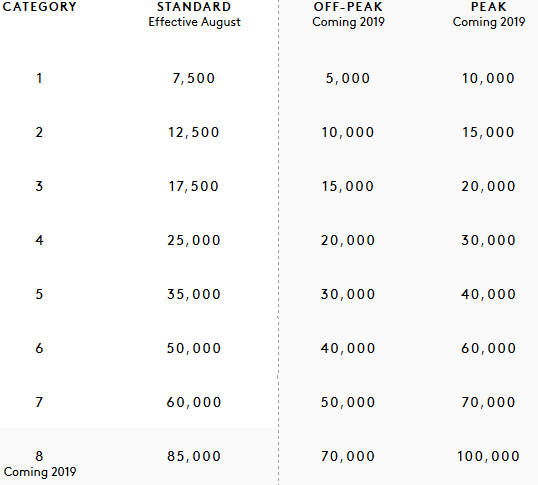
(Until 2019, only the Standard awards will apply and all hotels will belong to Categories 1-7. From 2019, Standard rewards will be the ‘normal’ reward type, with the number of points reduced during off-peak periods and increased during peak windows. No blackout dates will apply at any property.)
Converting reward points into airline frequent flyer points
One of the best ways to redeem Starwood Preferred Guest Starpoints is currently to convert them into frequent flyer points, which can be done at a 1:1 rate, and with a 25% bonus on every transfer of 20,000 points – giving you 25,000 frequent flyer points from 20,000 Starpoints.
The new program will keep this theme going by allowing members to convert their reward points at a 3:1 rate, and when you convert 60,000 reward points (20,000 frequent flyer points), you’ll get a bonus 15,000 reward points (5,000 frequent flyer points).
Remember, when you merge your existing Starwood Preferred Guest account with the new system, your existing SPG points balance will be tripled, so your points won’t lose their current 'value', as such.
Australian Business Traveller has confirmed that the new program will allow members to convert their points to both Qantas Frequent Flyer and Virgin Australia Velocity Frequent Flyer at that 3:1 rate – so while Qantas isn’t currently a transfer partner of SPG, and Velocity isn’t currently a transfer partner of Marriott Rewards, both these schemes will be attached to the single, new program.