
Qantas to launch free inflight Internet for Australian flights
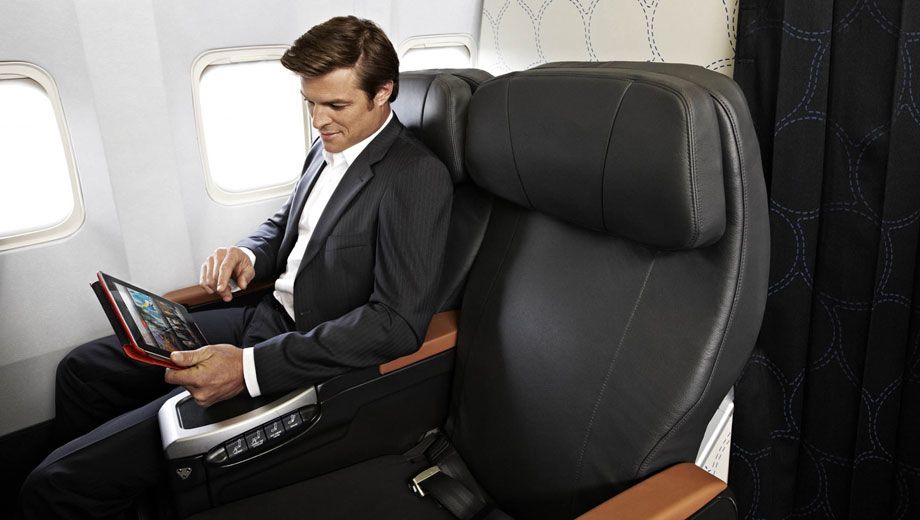
Qantas will launch free inflight Internet access later this year ahead of a planned rollout across its domestic Boeing 737 and Airbus A330 fleet.
The satellite-based service will deliver true 'broadband above the clouds', the airline claims, and be capable of streaming "movies, TV shows, news bulletins and live sports" to passengers' smartphones, tablets and laptops.
Tests will begin towards the end of 2016 on a single Boeing 737, with upgrades slated for the remainder of the Boeing 737 and Airbus A330 fleet from early 2017.
In a radical break from the industry norm, Qantas will make its inflight Internet free to all travellers – a move aimed to keep customers, especially business and corporate travellers, from the grasp of challenger Virgin Australia.
Satellite services operated by several international airlines – among them American Airlines, Etihad Airways and Singapore Airlines – cost in the vicinity of A$17 for two hours or A$25 for four hours, or on a data basis around A$20 for 15MB or A$40 for 30MB.
The need for speed
Most people know the experience of sharing a home Internet connection among several members of the family (especially when a new season of Game of Thrones airs).
The scenario of hundreds of Qantas passengers hooking up to a single satellite connection – which, being free, has zero barrier to entry and maximum appeal for that "I'm on a plane!" Facebook post, Tweet or in-seat selfie – will put Qantas' promises to the test.
Qantas Group CEO Alan Joyce told Australian Business Traveller that the speeds available inflight will be "four times what you can get on the ground", based on a conventional 'cable-type' connection.
"It's unbelievably exciting and a game-changer in terms of speed" he added.
"This doesn't just mean being able to check emails and Facebook... it means streaming your favourite TV show or movie from Sydney to Perth, or watching an entire cricket or rugby or football game in real time. It will be that fast."
So, how fast exactly?
Joyce declined to share the raw speeds but Qantas' partner ViaSat, which will manage the service, suggests "speeds that are up to 10 times faster than traditional global ground-based in-flight internet services" common in the USA, where ViaSat-equipped airlines can serve "speeds ranging from 12 to 20Mbps to each connected device."
By comparison, most home ADSL2+ connections max out around 10Mbps while older ADSL1 lines struggle to hit 8Mbps.
Even if the Qantas service can deliver only half of what ViaSat promises as its baseline, at 5Mbps, that's still sufficient for streaming Netflix content in HD.
Making sky-high WiFi work
Each of Qantas' Internet-capable aircraft will be fitted with a dual-band antenna tuned to the special 'Ka' and 'Ku' microwave bands respectively used by Australia's NBN Sky Muster satellites and ViaSat's own global satellite network.
This will allow aircraft to switch between the Sky Muster and ViaSat satellite networks to obtain the fastest available signal.
The first of two Sky Muster satellites was launched in October 2015 and will enter commercial service by mid-year, with a second bird to follow by the end of 2016.
Parked in a geostationary orbit 36,000 km above Australia, each satellite will blanket the continent and outlying territories with 101 highly-focussed 'spot beams' linked to a network of 10 ground stations.
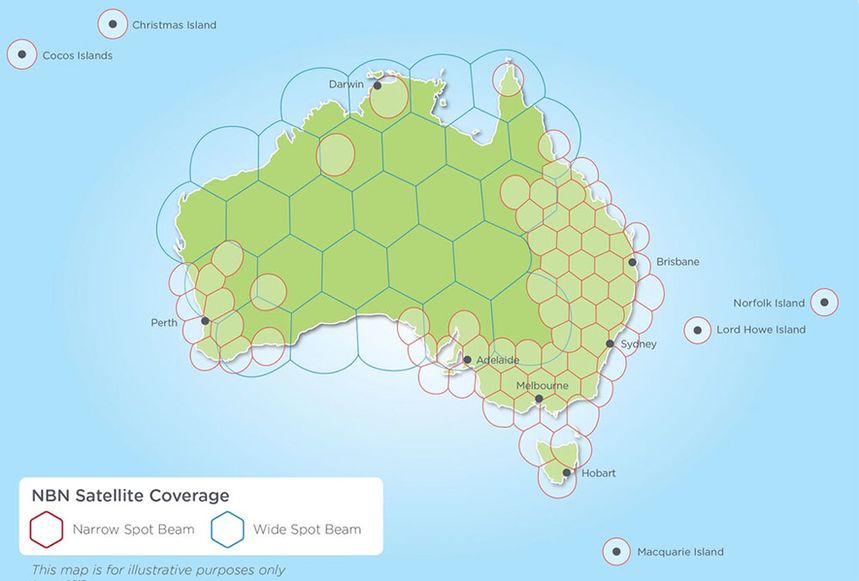
While the NBN satellites are primarily designed to provide broadband Internet to Australia's remote communities access they are also available to aircraft fitted with small radome antenna.
Trials to include Skype, FaceTime
Qantas is also courting controversy by an early decision to allow passengers to make Internet-based phone calls during the trial, using apps such as Skype and FaceTime.
"The trial will see us testing FaceTime and Skype to see whether people find that acceptable or not," Joyce said.
"We will be asking passengers what they think and what they want, to formulate the rules before rollout to the rest of the fleet."
Joyce says that Qantas "will also be looking at options for our international and regional fleets" and flagged that the technology could also end up on Jetstar aircraft, although in keeping with that airline's low-cost nature passengers would be required to pay for Internet access.
Snoozing trumps surfing
It's generally accepted that there is a greater appetite for inflight Internet on domestic flights – especially on Australia's transcontinental routes – than international flights, especially since around half of Qantas' international serves involve an overnight leg to Australia, which sees minimal demand because most passengers would rather sleep than surf the Web.
In late 2012 Qantas scrapped plans for Internet access on its flagship Airbus A380 fleet, citing a lacklustre response from travellers across a nine-month trial on selected superjumbo routes where the uptake was less than than 5%.
AusBT review: Qantas' A380 in-flight wifi Internet trials
Follow Australian Business Traveller on Twitter: we're @AusBT