
How to earn frequent flyer points on EVERY business expense

Paying your suppliers by credit card is one of the easiest ways to amass frequent flyer points on your business expenses, but there’s the age-old conundrum that some companies won’t accept plastic: instead requiring payment via electronic funds transfer.
That’s where RewardPay steps in: allowing you to pay any business with your American Express card, whether or not that business accepts AMEX or even credit cards at all, with the payment sent across to your supplier as a regular bank transfer.
It works like this: Australian businesses large and small can create an account on the RewardPay website using their ABN, and then enter the business and bank account details of the suppliers they’d like to pay.
When a bill falls due, simply return to the RewardPay website and whip out your AMEX to make that payment. Your card will be billed directly by RewardPay, along with a 2.64% processing surcharge, with the net amount remitted to your supplier by electronic funds transfer.
You can also add a reference name or number to appear with your payment so that it can be easily identified and applied to your invoice.
Paying bills, earning points via RewardPay
Crunching the numbers, paying a $23,500 invoice via RewardsPay would have your card billed $24,120.40, with $620.40 retained by RewardsPay and $23,500 sent to the supplier you specify.
Paying over $600 to process one invoice payment may be costly, but when using a card that earns 1.5 frequent flyer points per dollar spent – such as the Commonwealth Bank Business Awards Platinum AMEX – you could pull in the equivalent of 36,180 points with Virgin Australia Velocity.
Even after the airline’s own redemption rates change on June 1 2016, that’s still more than enough for a one-way flight from Sydney to Perth in The Business: Virgin Australia’s flagship and fully flat business class seat, plus a small payment of $17.47 in taxes and fees when booking.

Read: Virgin Australia A330 The Business review, Sydney-Perth
That puts your total cost of travel at $637.87 – being $620.40 in credit card surcharges to earn those points and $17.47 in taxes and fees when booking your flight.
Purchasing a ‘traditional’ business class ticket on the same route normally commands around $2,000 for the same seat, while flexible economy fares were priced at $639 on the dates we searched.
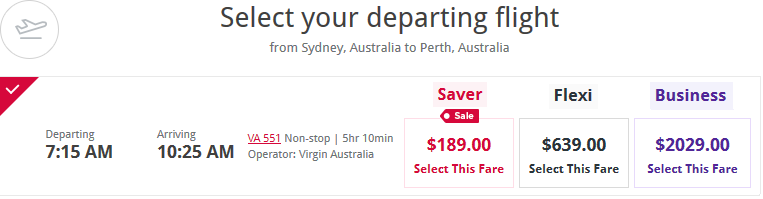
In other words you’re either flying in business class for less than you’d pay for a flexible economy ticket, or for almost 70% less than a traditional business class fare, just by paying your bills by credit card and paying a modest surcharge.
Naturally, your ability to book flights using frequent flyer points can vary from one day to the next, and you also won’t earn any additional Velocity points or status credits on the reward flight itself – but when you’re paying over $1,300 less for the same business class seat, it’s a fair compromise.
You may also be able to write-off RewardPay’s credit card surcharge as a tax deduction or business expense, so speak to your accountant.
Also read: Earn frequent flyer points when paying employee super
Follow Australian Business Traveller on Twitter: we're @AusBT